

If you hold a passport from one of 22 countries and regions — including the United States, Japan, the United Kingdom, Canada and Australia — you can enter South Korea visa-free without a K-ETA (Korea Electronic Travel Authorization) until 31 December 2026, Korean time. The trade-off: travellers using the exemption must file an arrival card, and the online e-Arrival card is free and opens 3 days before you land.
If you would rather have a K-ETA anyway, it costs ₩10,000 per person (about US$7–8) plus an online payment fee, processing usually takes 72 hours or less, and one approval covers multiple trips for 3 years. When we re-checked the K-ETA notice board on 8 October 2026, there was no notice extending the exemption into 2027. If your trip falls around the new year, start by working out whether you land before or after 31 December.
Is my country on the K-ETA exemption list?
The exemption covers 22 countries and regions: 5 in Asia, 2 in the Americas, 13 in Europe and 2 in Oceania. Anyone entering visa-free on one of these passports does not need a K-ETA until 31 December 2026. The exemption only removes the pre-travel authorisation step; each country’s visa-free stay limit still applies.
The country list comes from the Korean Embassy in Spain’s notice on K-ETA-exempt countries and regions (Korean, posted 23 December 2025), and the stay limits from the eligible-countries list on the official K-ETA website. The United States entry includes Guam, and the notice adds that Andorran citizens entering visa-free still need a K-ETA before travel.
| Region | Exempt countries and regions | Visa-free stay per entry |
|---|---|---|
| Asia (5) | Japan, Taiwan, Hong Kong, Singapore, Macao | 90 days for all |
| Americas (2) | United States (incl. Guam), Canada | US 90 days, Canada 6 months |
| Europe (13) | United Kingdom, Germany, France, Italy, Netherlands, Spain, Poland, Sweden, Finland, Norway, Belgium, Denmark, Austria | Netherlands and Belgium 3 months; British citizens (GBR passport) and the rest 90 days |
| Oceania (2) | New Zealand, Australia | New Zealand 3 months, Australia 90 days |
Who never needs a K-ETA, whatever their passport
Some travellers are outside the K-ETA requirement altogether. According to the K-ETA website’s exemption list, people aged 17 or younger or 65 or older on the date of entry have been exempt since 3 July 2023. Visa holders, registered foreign residents, diplomatic, official and UN passport holders, ABTC (APEC Business Travel Card) holders, aircraft and ship crew, active-duty US service members under the SOFA, and cruise passengers do not apply either.
Transit passengers are exempt in principle, but if your plans change and you enter Korea, or you go through immigration to collect checked baggage, you need a K-ETA in advance. Dual nationals who hold Korean citizenship enter on their Korean passport, so K-ETA does not apply to them.
Will I need a K-ETA again for trips from January 2027?
The official notice says only that the exemption runs from Thursday 1 January to Thursday 31 December 2026 (KST); as of 8 October 2026 there is no notice about 2027. The exemption is described as temporary, and exempt countries such as the US and Japan remain on the list of countries eligible to apply for K-ETA. If you will arrive on or after 1 January 2027, the safe plan is to budget for a K-ETA in case no further extension is announced.
The Korean Embassy in the USA’s notice on the extension (29 December 2025) repeats the Ministry of Justice’s decision to extend the exemption by one more year to support tourism. When we reopened the K-ETA notice board on the morning of 8 October 2026, the three newest posts were a 30 September system-maintenance notice, a 7 January how-to-apply guide and the December 2025 extension notice. Nothing yet covers an exemption or fees for 2027.
If your trip straddles the new year
The notice gives the end date as 31 December 2026, Korean time, and nothing more. If you fly out in late December and land in early January, check what the date will be in Korea when you arrive. If arrival falls in 2027 and no extension has been announced by then, getting a K-ETA before departure is the safer choice, because travellers who need one must be approved before boarding.
A K-ETA you already hold stays valid until it expires regardless of the exemption, and fees already paid are not refunded. If you apply during the exemption, a “K-ETA exempt” pop-up appears when you scan your passport photo page; if you want to skip the arrival card, you can carry on with the paid application.
How early to apply so you are not caught out
You must have K-ETA approval before boarding your flight or ship. The official guide warns that applying after boarding or once you are already in Korea can lead to refusal or entry restrictions. Applications are processed in the order received with no express service, so leave far more than 72 hours — applying the day you book your flight is a good habit.
How much is K-ETA, how long does it take and how long is it valid?
K-ETA costs ₩10,000 per person (about US$7–8), plus an online payment fee of about 3%, and the fee is not refunded if you are refused. Processing usually takes 72 hours or less but can run longer when applications surge. An approved K-ETA can be used for multiple entries for 3 years (or until your passport expires, if sooner), and approved travellers do not need to fill in an arrival card.
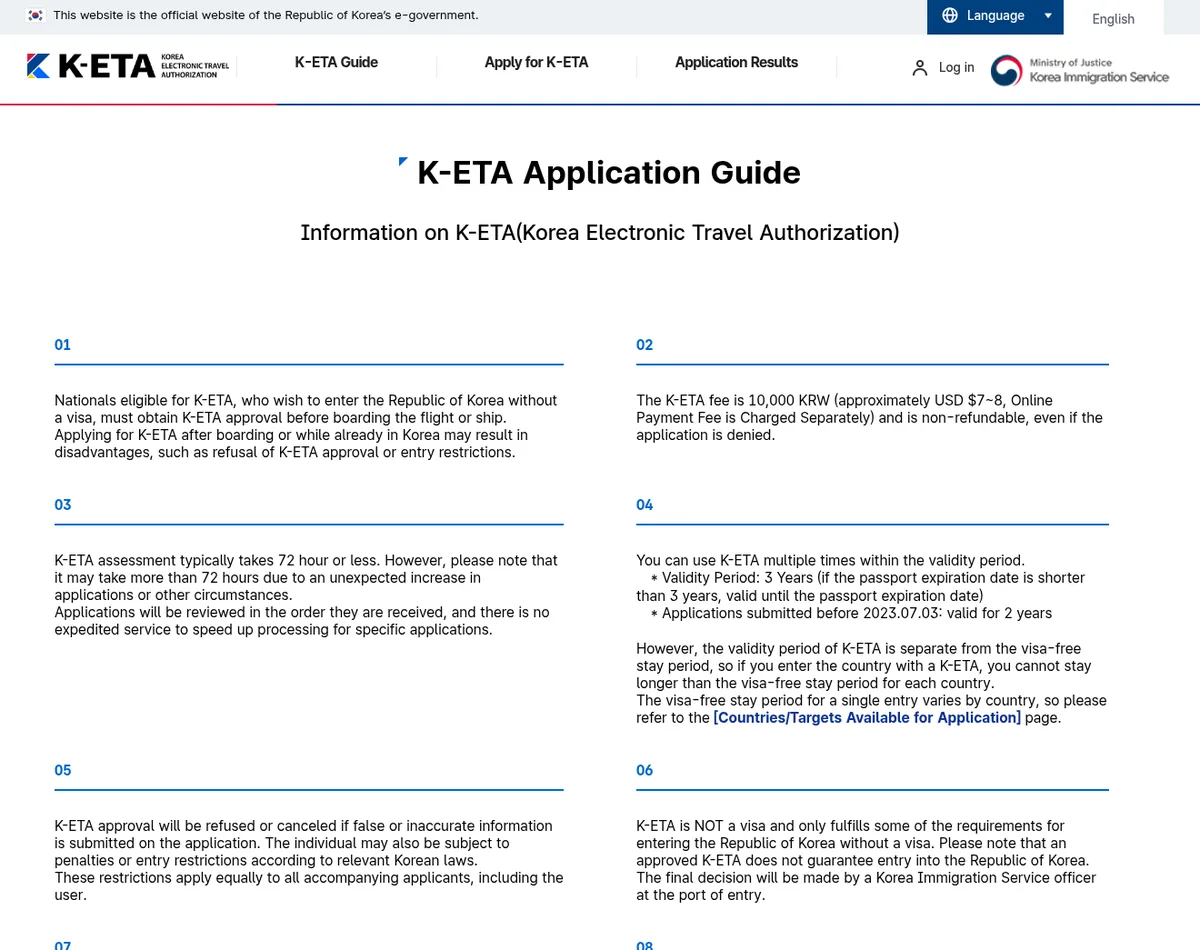
These figures follow the official K-ETA Application Guide and the K-ETA Application Fee Guide. You can pay with VISA, MASTER, JCB, AMEX, Diners Club, DISCOVER, UnionPay or Alipay+, and payment can fail if your card blocks overseas transactions.
| K-ETA (travel authorisation) | e-Arrival card | |
|---|---|---|
| What it is | Pre-boarding authorisation for visa-free entry | The paper arrival card, filed online |
| Official site | www.k-eta.go.kr | www.e-arrivalcard.go.kr |
| Cost | ₩10,000 per person + about 3% payment fee; no refund if refused | Free |
| When to file | Must be approved before boarding; usually 72 hours | From 3 days before arrival (KST) |
| How long it lasts | 3 years (or to passport expiry), multiple entries | Lapses 72 hours after submission or once you clear immigration |
| Group filing | Accompanying applicants can be added | Up to 9 people on mobile, up to 1,000 on a PC |
| Citizens of exempt countries in 2026 | Not needed (optional, paid) | Required (unless you hold a K-ETA) |
The 7 application steps and what to have ready
The steps are almost identical for members and non-members: (1) agree to the terms, (2) sign up (non-members verify an email address instead), (3) enter passport details, (4) enter application details, (5) check the information, (6) pay, and (7) complete the application. You need a valid passport, a working email address, an ID photo and a credit or debit card for the fee.
When an approved K-ETA has to be redone or updated
Even with time left on your K-ETA, you must apply again if your passport is reissued or your criminal record or infectious-disease information changes. If your purpose of entry, address in Korea, contact details, planned arrival or departure date, departure flight or accompanying travellers change, update them under “Update Travel Information” on the K-ETA site; failing to do so can lead to entry refusal.
The 3-year validity is not the same as how long you may stay. Entering on a K-ETA, a US citizen still cannot stay more than 90 days per visit, or a Canadian more than 6 months. K-ETA is not a visa, so the final decision rests with the immigration officer at the airport, and if you also hold a valid visa, the visa’s status and period of stay take priority.
Entering without a K-ETA: how do I file the arrival card?
Anyone using the 2026 exemption has to file an arrival card. The e-Arrival card is free on the official website, can be filed from 3 days before you arrive in Korea (KST), and carries the same legal effect as the paper card. Once you have filed it online, you do not need to fill in a paper card on the plane or at the airport.
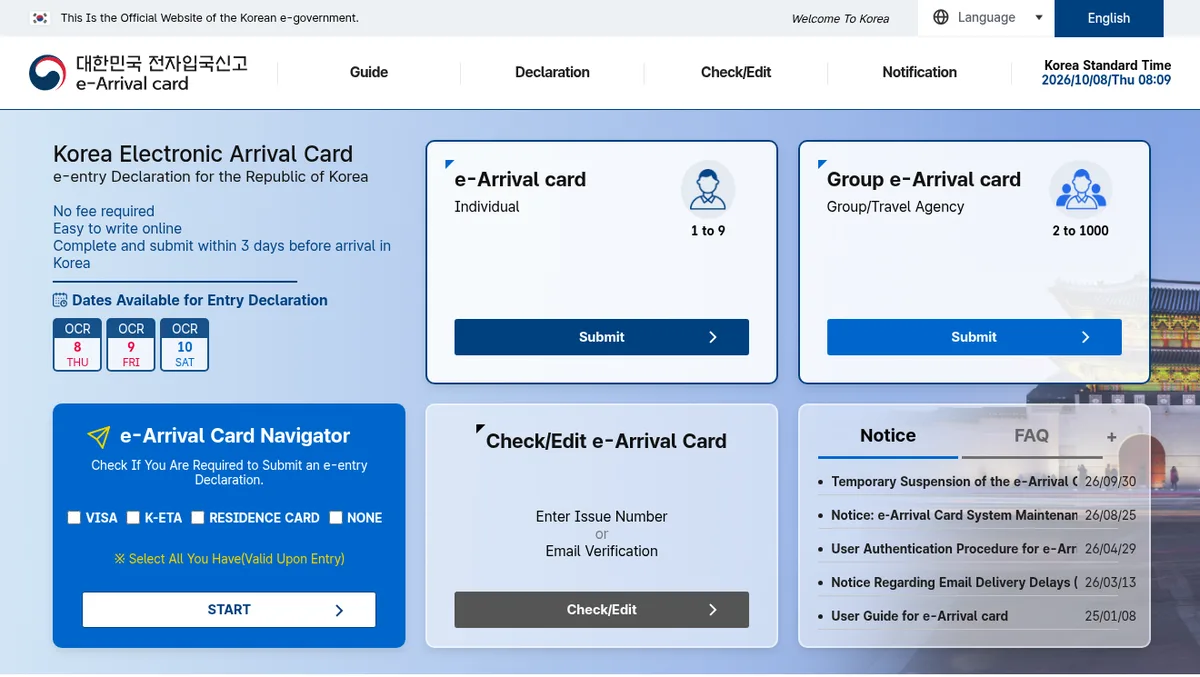
Going by the e-Arrival card guide and the same site’s guide to who must file, Korean visa holders and K-ETA-exempt travellers (including 2026 exempt-country citizens and those exempt by age) must file, while K-ETA holders and holders of a Korean residence card, permanent resident card or Overseas Korean Resident Card are excluded. The exception: a K-ETA holder who enters on a visa must still file.
To fill it in you need a valid passport, an email address, your arrival date and flight number, and where you will stay; your departure date and flight are optional. The issue number arrives by email — you do not have to show it at immigration, but it helps to have it to hand. If your purpose of entry, accommodation or departure date changes, you can edit the card on the same site until you clear immigration, though the arrival date itself can only be changed within 3 days of first filing.
Worked examples: what a family trip costs
Example 1: a US family of four arriving in December 2026 (parents aged 45 and 43, children aged 15 and 12). The trip falls inside the exemption, so K-ETA costs nothing; all four file an arrival card. The e-Arrival card takes up to 9 people in one go even on a phone, so one person can file for the whole family. If the parents want to skip the arrival card by getting a K-ETA, that is ₩10,000 × 2 = ₩20,000 plus a 3% payment fee (₩600), or ₩20,600 in total.
Example 2: the same family arriving in January 2027, assuming no extension is announced. At today’s official fee, the two parents would need a K-ETA for ₩20,600 in total, while the children, aged 17 or under on the date of entry, are outside the K-ETA requirement. The children file an arrival card instead, or can get an optional paid K-ETA.
Example 3: a Japanese mother (67) and her son (40) visiting in March 2027. The mother is 65 or older, so she needs no K-ETA and just files the arrival card. The son pays ₩10,000 plus a ₩300 payment fee, ₩10,300 in total; approved in January 2027, his K-ETA covers multiple trips for 3 years, so a visit in late 2029 is still covered. If he renews his passport in the meantime he must reapply, and if the passport expires sooner than 3 years, the K-ETA ends on that date.
How to avoid fake “agent” websites
A pop-up on the official e-Arrival card homepage states that www.e-arrivalcard.go.kr is the only official site and that any website asking for payment details is not an official service. The e-Arrival card is free, so treat any site that charges for it as suspect. The K-ETA notice board also carries a warning about non-official websites and agencies; check that the address is www.k-eta.go.kr and pay only the ₩10,000 fee.
FAQ
Q. My parents are US citizens visiting in November 2026. Do they need a K-ETA?
A. No. The United States is one of the 22 temporarily exempt countries and regions, and the exemption runs to 31 December 2026 (KST). They do need to file an arrival card; the e-Arrival card is free and opens 3 days before arrival.
Q. Will the K-ETA exemption continue in 2027?
A. As of 8 October 2026, the K-ETA notice board only has the notice extending the exemption to 31 December 2026, with nothing about 2027 or later. If you are arriving in 2027, watch for notices and be ready to get a K-ETA.
Q. If I get a K-ETA, can I skip the arrival card?
A. Yes. K-ETA holders are exempt from filing an arrival card. However, if you hold a K-ETA but enter on a visa, you must file the e-Arrival card.
Q. How long does K-ETA approval take, and is the fee refunded if I’m refused?
A. It usually takes 72 hours or less but can take longer when applications surge, and there is no express service. The ₩10,000 fee covers the assessment and is not refunded if you are refused.
Sources
- Embassy of the Republic of Korea in the USA — Notice on Extension of K-ETA Temporary Exemption (~12/31/2026)
- Ministry of Justice K-ETA — K-ETA Application Guide (processing time, validity, arrival-card exemption, reapplication)
- Ministry of Justice K-ETA — Application Fee Guide (₩10,000, about 3% payment fee, accepted cards)
- Korean Embassy in Spain — list of the 22 K-ETA-exempt countries and regions (Korean)
- Ministry of Justice — Korea e-Arrival card guide (free, 3 days before arrival, 72-hour validity)
Leave a Reply