
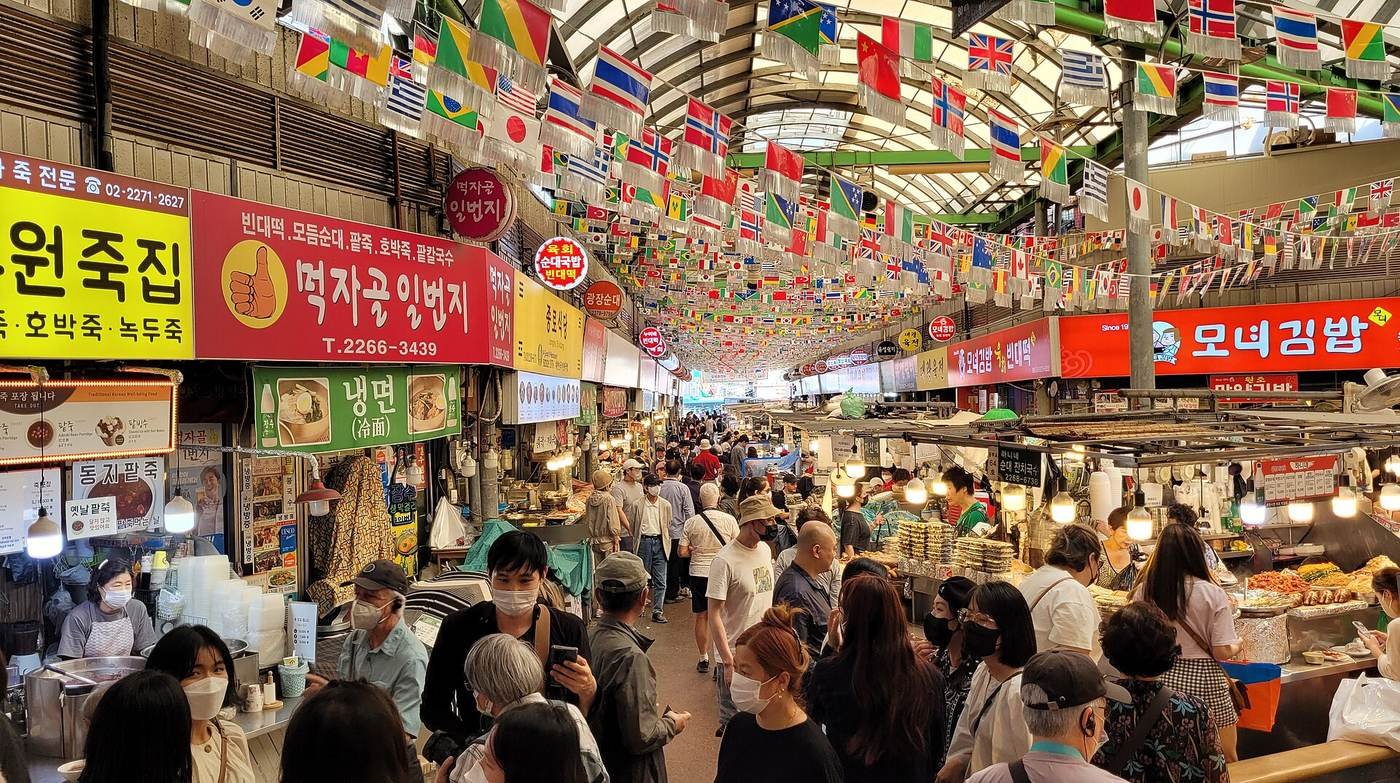
Gwangjang Market is a traditional market at 88 Changgyeonggung-ro, Jongno-gu, Seoul, and its food alley of street-food stalls is open 09:00–23:00 every day of the year. The general shops selling fabric, hanbok and groceries open Monday to Saturday, 09:00–18:00, and the vintage clothing arcade on the 2nd floor opens 10:00–19:00. Both of those close on Sundays, so on a Sunday the food alley is the only part of the market that is open.
By subway, the market is 62 m from Exit 8 of Jongno 5-ga Station on Line 1, or 100 m from Exit 4 of Euljiro 4-ga Station on Lines 2 and 5. The dishes to try first are mung bean pancakes (bindaetteok) fried to order, yukhoe (Korean beef tartare) and bite-size mini gimbap, nicknamed “mayak gimbap.” Payment can differ from stall to stall, so carry a little cash and ask whether cards are accepted before you order. For anything else, the market’s contact number is +82-2-2267-0291.
What should I eat at Gwangjang Market on a first visit?
Start with three things: bindaetteok, yukhoe and mini gimbap. These are the dishes that Seoul’s official tourism site and Jongno-gu’s district guide both single out, along with modum-jeon, a plate of assorted savory pancakes. Around them you will find sundae (Korean blood sausage) with head meat, tteokbokki and fish cakes, bibimbap, kalguksu noodles and janchi guksu.
The VisitSeoul guide to Gwangjang Market lists bindae-tteok, modum-jeon, mayak gimbap and beef tartare among the market’s best-known foods. Jongno-gu’s English guide describes Gwangjang as Korea’s first permanent market and explains that its name comes from two old bridges over the Cheonggyecheon stream, Gwanggyo and Janggyo. Food stalls sit right among the fabric, hanbok and grocery shops, so you will share the aisles with locals doing their shopping as well as visitors who came to eat.
Bindaetteok, fried on the griddle in front of you
Jongno-gu’s tourism page puts mung bean pancakes, “fried on the spot,” at the top of its food list. Vendors pour a mung bean batter onto a wide, well-oiled griddle and fry it on both sides, so you hear the sizzle and smell the oil before you even reach the stall. A pancake straight off the griddle is crisp at the edges and soft inside, and it is best eaten right away.
You can also try modum-jeon, an assortment of different savory pancakes on one plate, and donggeurangttaeng, small Korean meat patties. If you are in a group, one bindaetteok plus a plate of modum-jeon to share is an easy way to taste several things in one sitting.
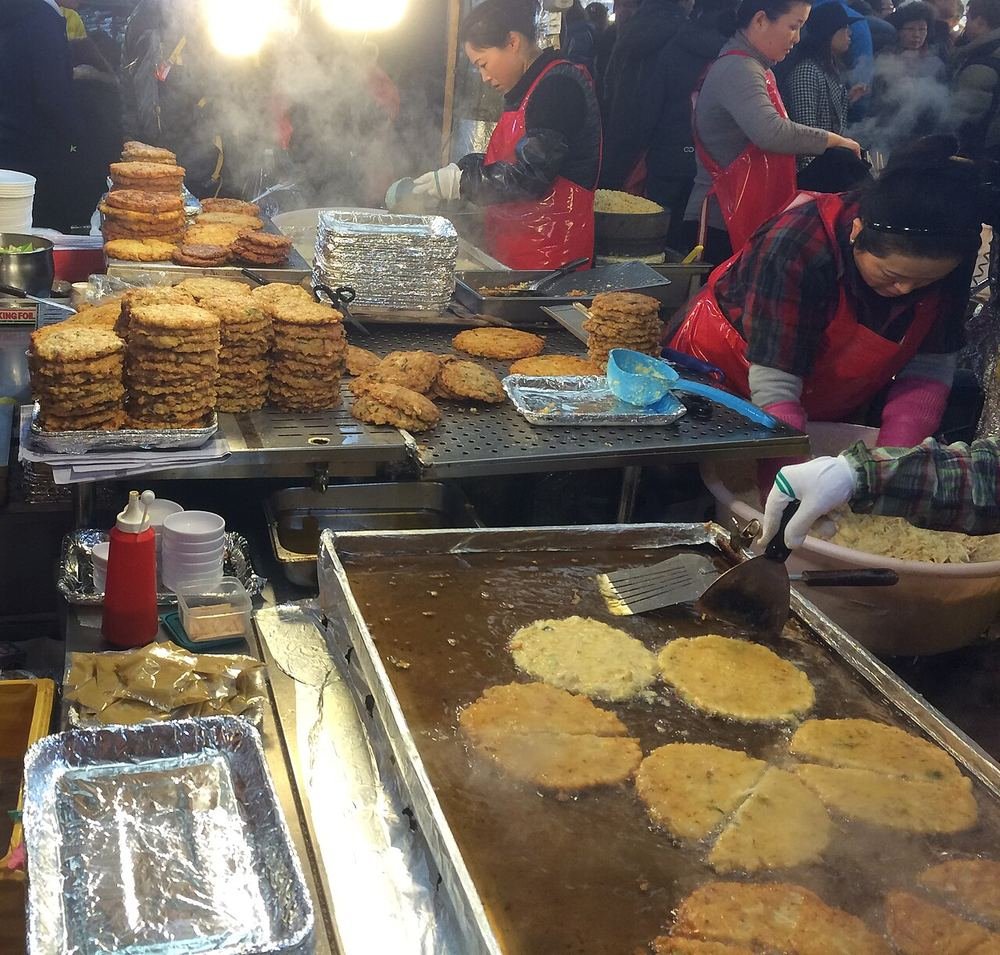
Bindaetteok turning golden on an oiled griddle, with finished pancakes stacked high behind it. 2016, Rystheguy, CC BY-SA 4.0. Original on Wikimedia Commons.
Yukhoe in the market’s raw beef lane
Jongno-gu’s food guide notes that Gwangjang Market is lined with yukhoe places and raw fish restaurants. Yukhoe is raw beef cut into thin strips, seasoned and topped with an egg yolk, which you break and mix into the meat before eating. Because it is a raw dish, it is better to sit down and eat it straight away than to carry it around like a pancake or gimbap.
Check the price board at the front of the shop for the menu and portion sizes before you order. That way there are no surprises when you pay, and the city’s 2026 inspections specifically check that prices are properly displayed.
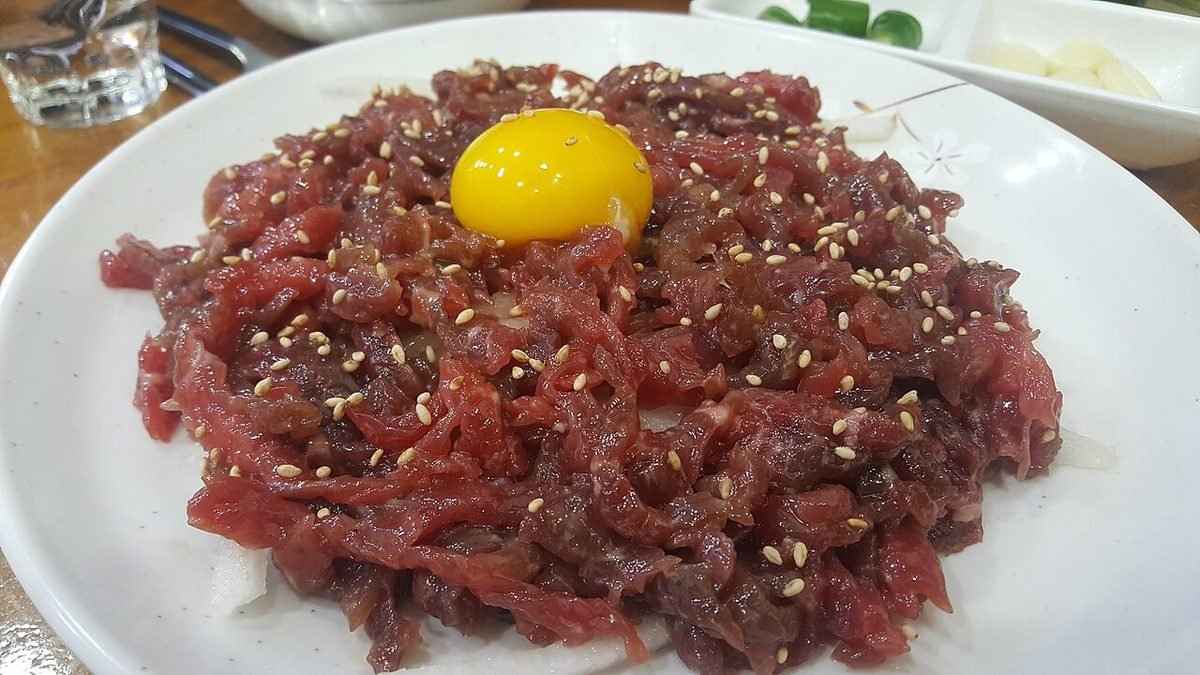
Yukhoe on a white plate, topped with an egg yolk and a sprinkle of sesame seeds. 2017, Choi2451, CC BY-SA 3.0. Original on Wikimedia Commons.
Mini gimbap, and why people call it “mayak gimbap”
According to Jongno-gu, the market’s mini gimbap is filled with nothing more than pickled radish, spinach and carrot, and it goes by the nickname “mayak gimbap.” “Mayak” means narcotic in Korean, a joke about how hard the rolls are to stop eating, and VisitSeoul describes them as gimbap eaten with an addictive dipping sauce. They are small and simple, which makes them a good light bite before you move on to pancakes or yukhoe.
At some stalls, as in the photo below, the vendor rolls the gimbap right there while customers sit on stools around the counter and eat. If one stall is packed, simply try the next one.
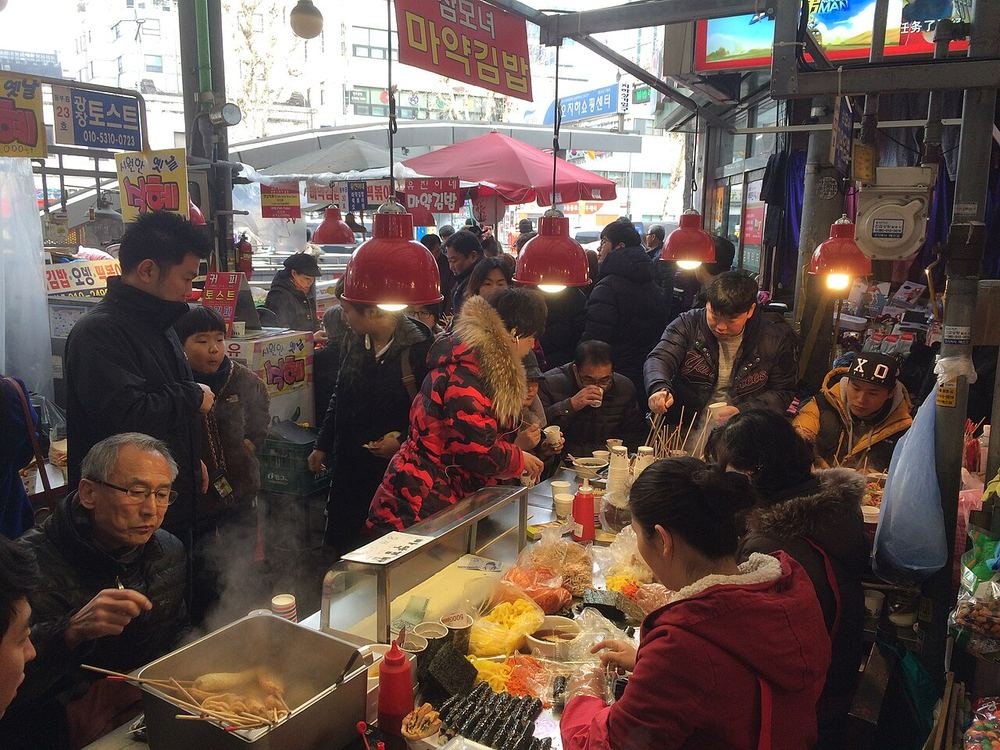
Customers gathered around a gimbap stall under red lamps, a vendor rolling gimbap, and a “mayak gimbap” sign overhead. 2016, Rystheguy, CC BY-SA 4.0. Original on Wikimedia Commons.
When do the food alley, the shops and the vintage arcade open?
Each section of Gwangjang Market keeps its own hours. The food alley is open 09:00–23:00 all year, the general shops are open Monday to Saturday 09:00–18:00, and the 2nd-floor vintage clothing arcade is open 10:00–19:00. After 18:00 the general shops close, and after 19:00 only the food alley is still open.
The table below follows the market’s official opening-hours notice (in Korean), checked against VisitSeoul. Some English pages mix “daily” and “closed Sundays” in the same line, so go by these hours.
| Section | Hours | Closed |
|---|---|---|
| Food alley (street-food stalls) | 09:00–23:00 | Open all year |
| General shops (fabric, hanbok, groceries) | Mon–Sat 09:00–18:00 | Sundays (individual shops’ days off vary) |
| Vintage clothing arcade, 2nd floor | 10:00–19:00 | Sundays (open on public holidays) |
What is open at each time of day
From 09:00 to 10:00 the food alley and the general shops are open, but the vintage arcade has not opened yet. From 10:00 to 18:00, Monday to Saturday, all three sections are open, which makes it the best window for browsing fabric and hanbok, shopping for vintage clothes and eating in one visit. From 18:00 to 19:00 the vintage arcade and the food alley remain, and from 19:00 to 23:00 it is the food alley alone.
If vintage shopping is part of the plan, arrive by around 17:00, look around the arcade first, then head down to the food alley. If you are coming for dinner after work, the food alley stays open until 23:00, so there is no rush.
If you are heading to one particular shop
Jongno-gu’s tourism page says that individual shops set their own days off. The hours in the table apply to the market as a whole, so if you are going to a specific fabric or hanbok shop, check that it is open that day. If you cannot reach the shop, call the market at +82-2-2267-0291.
Is anything open on Sundays and public holidays?
On Sundays only the food alley is open. The general shops and the 2nd-floor vintage arcade close every Sunday, while the food alley keeps its usual 09:00–23:00 hours all year. On public holidays the vintage arcade also opens as normal, 10:00–19:00, according to the market’s official notice.
If you choose Gwangjang Market for a Sunday outing, plan it around food rather than shopping. The fabric lanes and hanbok shops may have their shutters down, but the bindaetteok, yukhoe and gimbap stalls in the food alley are open as usual.
Planning a public holiday visit
On public holidays both the food alley and the vintage arcade are open, so you can combine vintage shopping with a meal. If you also want to visit the general shops, call +82-2-2267-0291 first to ask whether they are open that day. The food alley keeps the same 09:00–23:00 hours on holidays too.
For more Seoul neighborhoods to pair with the market, see our guide to Seoul neighborhoods to visit.
Which subway station and exit are closest?
If you are on Line 1, Exit 8 of Jongno 5-ga Station is the closest, 62 m from the market according to VisitSeoul. On Line 2 or Line 5, use Exit 4 of Euljiro 4-ga Station, which Jongno-gu lists as 100 m away. Either way it is a short walk from the exit.
For a map app or taxi, the street address is 88 Changgyeonggung-ro, Jongno-gu, Seoul. Showing the address together with the Korean name of the market makes things easier for a taxi driver.
Which gates lead straight to the food alley
According to the Korea Tourism Organization’s English guide, the food alley connects to the East Gate, North Gate 2 and South Gate 1. The market building has several entrances, so if food is your goal, use whichever of these three is nearest. If you come in through another entrance, follow the aisle lined with food stalls further inside.
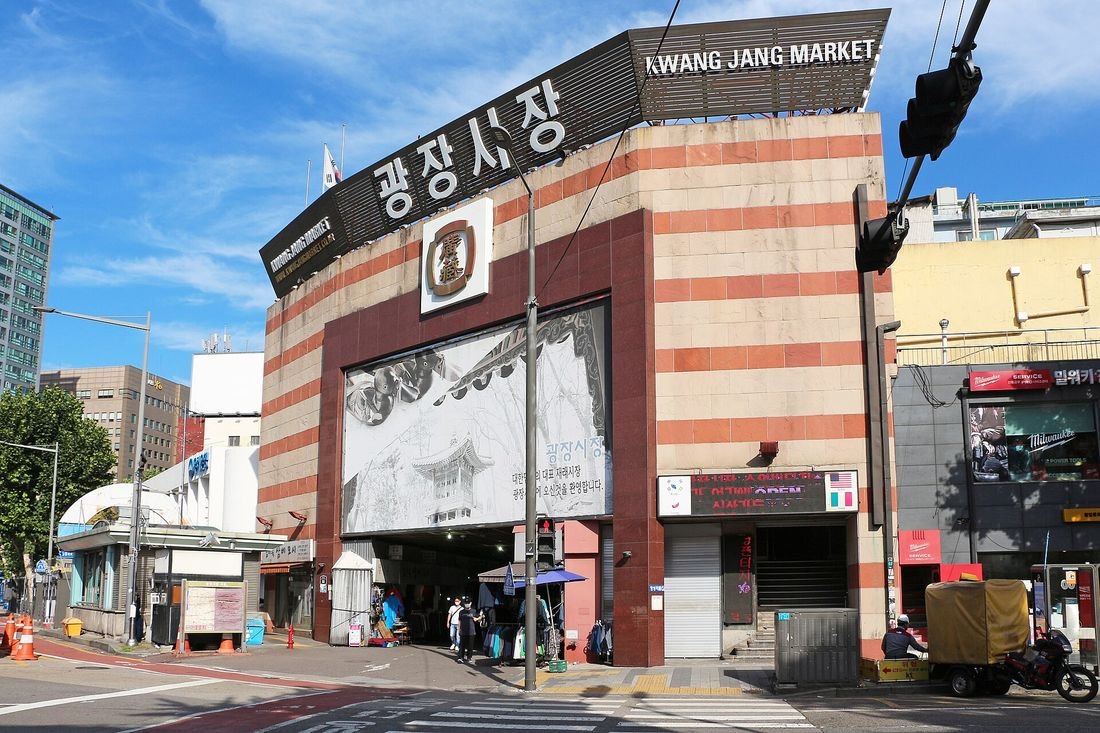
A Gwangjang Market entrance building with its name sign in Korean and in English, “KWANG JANG MARKET.” 2022, Bgag, CC0. Original on Wikimedia Commons.
If you are driving
VisitSeoul points drivers to the Jongmyo public parking lot in Jongno 4-ga. Check the parking fee and hours with the lot before you go. With two subway stations right by the market, the subway is the easier choice if you plan to linger over pancakes and yukhoe into the evening.
Should I bring cash or a card, and how does ordering work?
Bring a little cash and ask whether a card is accepted before you order. VISITKOREA’s basic information for the market says cards are accepted, but the street stalls are a different story. Jongno-gu and the merchants’ association only introduced a card-payment agency service for 77 unregistered street stalls in July to September 2024, so how you can pay may vary from stall to stall.
At the stalls you simply sit on the stool or bench in front and tell the vendor what you want. Look at the menu and price board before you sit down, ask how you can pay, then order. It makes paying smoother for both sides.
How to read the menu and prices
According to the local Jongno-gu newspaper, 88 food stalls introduced multilingual QR menus between May and July 2024. Scan the QR code with your phone and you can see the menu, photos and prices in 20 languages. At stalls without a QR menu, go by the price board posted at the front.
The 2026 inspections and where to report a problem
A Seoul Metropolitan Government press release of May 20, 2026 says that the city and Jongno-gu ran a joint intensive inspection of Gwangjang Market in May and June and have continued with regular checks and ongoing monitoring. Korean and foreign mystery shoppers check for overcharging, forced sales and unfair treatment of foreign visitors, and a real-name system for street stalls has applied since June. Repeated violations lead to penalty points, then business suspension, and can end with the stall losing its road-occupancy permit.
Back in December 2023 the city also added “no pushing customers to pay in cash” to its training for the merchants’ association. If something goes wrong when you order or pay, call the 1330 Korea Travel Hotline.
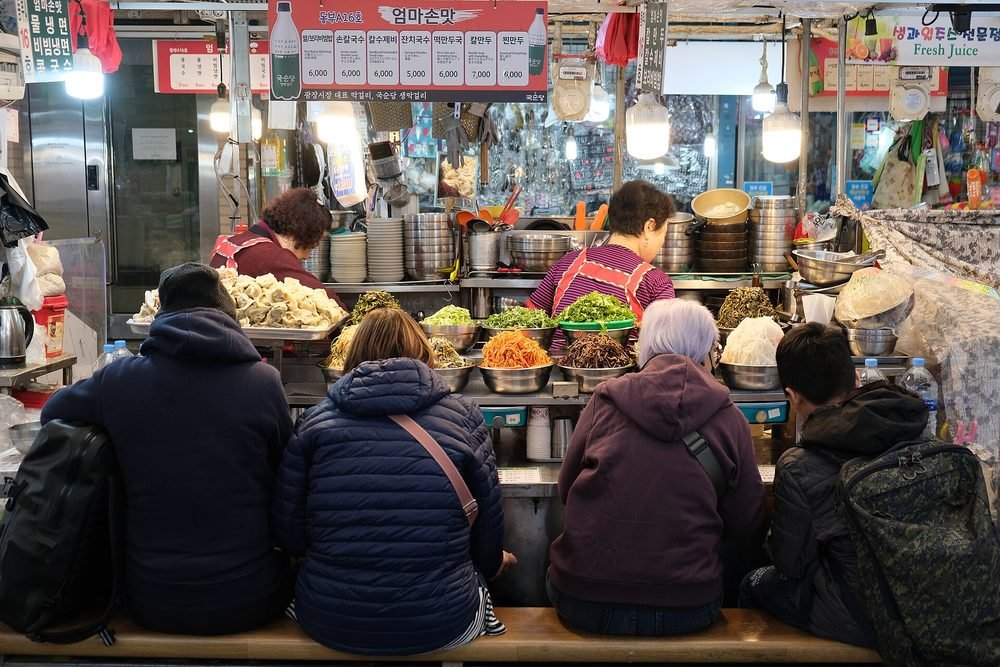
Diners side by side on a long bench at a stall displaying bowls of seasoned vegetables and dumplings. 2022, kallerna, CC BY-SA 4.0. Original on Wikimedia Commons.
Frequently asked questions
Q. What time does the Gwangjang Market food alley close?
A. The food alley is open 09:00–23:00 every day of the year. The general shops are open Mon–Sat 09:00–18:00, and the 2nd-floor vintage arcade 10:00–19:00.
Q. Is Gwangjang Market open on Sundays?
A. Only the food alley is open on Sundays, at its usual 09:00–23:00. The general shops and the 2nd-floor vintage arcade are closed.
Q. Which subway exit should I use for Gwangjang Market?
A. Use Exit 8 of Jongno 5-ga Station on Line 1 (62 m), or Exit 4 of Euljiro 4-ga Station on Lines 2 and 5 (100 m). The address is 88 Changgyeonggung-ro, Jongno-gu, Seoul.
Q. Can I pay by card at Gwangjang Market’s food stalls?
A. It varies from stall to stall: 77 street stalls only got a card-payment agency service in 2024. Carry a little cash and ask before you order.
Sources
- Gwangjang Market official site — opening hours by section (Korean)
- VisitSeoul — Gwangjang Market (address, Exit 8, signature foods, parking)
- VISITKOREA — Gwangjang Market (cards, food alley gates)
- Jongno-gu Office — Gwangjang Market (Euljiro 4-ga Exit 4, name origin, first permanent market)
- Jongno-Cheonggye Special Tourist Zone — Gwangjang Market (shop days off, signature foods, Korean)
- Jongno-Cheonggye Special Tourist Zone — Food (mung bean pancakes, yukhoe, mini gimbap, Korean)
- Seoul Metropolitan Government press release (2026-05-20) — inspections, mystery shoppers, stall real-name system (Korean)
- Seoul city news (2023-12-04) — market measures and merchant training (Korean)
- Jongno-gu newspaper (2025-11-06) — QR menus and stall card payments (Korean)
- Featured photo: the food alley at Gwangjang Market under strings of flags, Bgag (2022), CC0, Wikimedia Commons
Leave a Reply