
Book Templestay through the Cultural Corps of Korean Buddhism sites templestay.com and English eng.templestay.com. More than 140 temples are listed nationwide, and the integrated info center is 02-2031-2000. Sample overnight-class fees checked on official program pages on 2026-09-20: Hwagyesa and Guinsa adults ₩70,000, Jinkwansa temple-food program ₩80,000, Bongsunsa weekend experiential adults ₩100,000. Always re-check the session page before you pay.
Where do you book a Templestay?
The official channels are templestay.com and eng.templestay.com. Filter by region, temple, type (day / experiential / relaxation), date, and party size, then read that session’s fee, schedule, language, and refund rules before checkout. Third-party products (for example Klook) can differ in price or itinerary — treat the official session page as final.
| Step | What to do |
|---|---|
| 1 | Open templestay.com or eng.templestay.com → pick ENG / 中文 / 日本語 |
| 2 | Reservation → filter region, temple, type, date, guests |
| 3 | Open program detail: fee, schedule, language, refund |
| 4 | Member or guest booking → passport name (English), nationality, contact |
| 5 | Pay (card / some PayPal / bank) → confirmation email or SMS |
| 6 | Before arrival: packing, dress, no alcohol/smoking rules |
Contact: Templestay Integrated Information Center 02-2031-2000, support@templestay.com, 4F, 56 Ujeongguk-ro, Jongno-gu, Seoul. Guest booking works, but passport spelling must match confirmation messages. Popular temples on weekends fill early — pick dates first, then open slots. Same-day walk-ins often find no seats.
How much does it cost? (2026 samples)
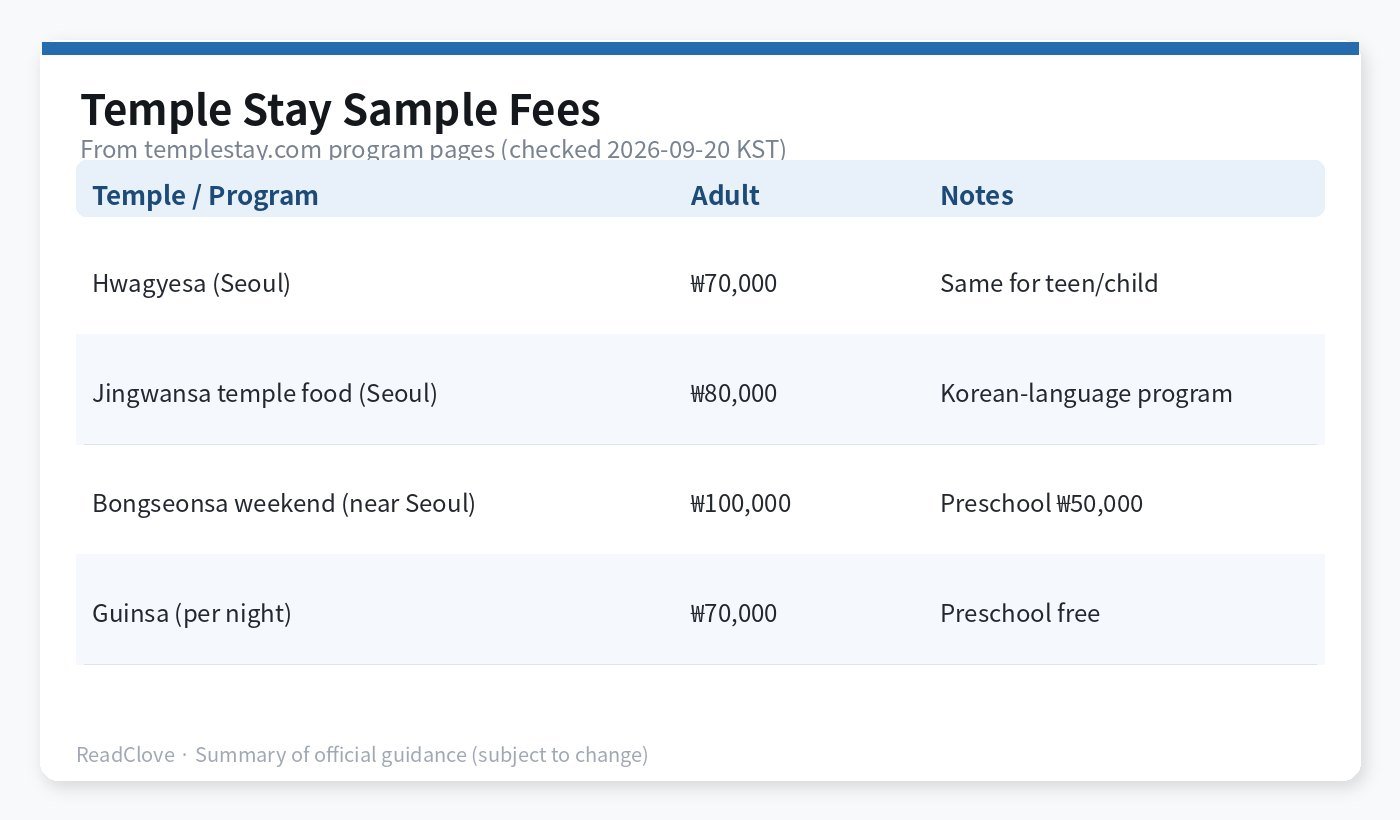
Fees differ by temple and program. The table below is a sample captured from official pages on 2026-09-20 — not a nationwide flat rate.
| Temple | Program type | Adult | Notes |
|---|---|---|---|
| Hwagyesa (Gangbuk, Seoul) | Experiential overnight-class | 70,000 | Teen/Child also 70,000 |
| Jinkwansa (Eunpyeong, Seoul) | Temple-food experience | 80,000 | Marked Korean-language |
| Bongsunsa (Namyangju) | Weekend experiential | 100,000 | Middle/high/elementary 100,000 / preschool 50,000 |
| Guinsa | Per night | 70,000 | Preschool 0 |
Sources: Hwagyesa Price List, Jinkwansa fee page, Bongsunsa weekend page, Guinsa Per night Price List.
Quick math
Two adults at Hwagyesa (₩70,000 each) pay ₩140,000 in program fees. The same pair at Bongsunsa weekend experiential (₩100,000 each) pays ₩200,000. At Guinsa overnight (adult ₩70,000 / preschool 0), you pay only for adults. Jinkwansa temple food is ₩80,000 and listed as Korean-language — pick another session if you need a foreign-language guide. Day / relaxation / special events can differ from the table. Secondary guides sometimes cite Bongeunsa day Temple Life around ₩30,000 or overnight meditation around ₩100,000 — use those only as leads; pay against the official session page.
Day, experiential, and relaxation — what’s the difference?
Programs generally fall into day, experiential, relaxation, and group types. Experiential sessions pack chanting, 108 bows, seated meditation, and tea ceremony; relaxation programs leave more free time around lodging and meals. Even at one temple, language, activities, and fees change by session. Day programs often cost less than overnight ones, but again — check the session.
Common activities
- Chanting and meal etiquette
- 108 bows, meditation, tea ceremony
- Temple tour and walk
- Temple-food workshops (some sites such as Jinkwansa)
First-timers usually find experiential programs clearer. If you already know temple routines and want quiet rest, read relaxation descriptions carefully. Group sessions open for schools, companies, or clubs.
Refunds and cut-offs
Refund rules differ by temple and program. Some pages note booking cut-offs 2–3 days before the start and refund processing of 5–7 days. Read the cancel window before you pay. Weather or temple schedule changes follow the notice email/SMS.
Foreign visitors, payment, and language
Foreign visitors can join. eng.templestay.com offers English / Chinese / Japanese UI, and each session lists the language of instruction. Seoul-area temples often recommended for international guests include Bongeunsa, Geumseonsa, Hwagyesa, International Seon Center, Jinkwansa, Jogyesa, and Myogaksa. Whether that day runs in English is on the session label — do not assume a Korean-only temple-food session has a foreign-language guide.
If a foreign card is declined, ask that temple about PayPal or bank transfer, or try Korea Travel Hotline ☎1330 (overseas +82-2-1330). Match passport English name, nationality, and contact to the booking fields. If confirmation never arrives, call 02-2031-2000 or email support@templestay.com first.
What to pack and temple etiquette
Most temples lend practice clothes plus bedding. Bring socks, toiletries and a towel, comfortable sneakers, an extra outer layer, and a tumbler. No alcohol or smoking; avoid revealing clothes and loud behavior. Follow staff guidance during chanting and meals. In winter an outer layer helps for dawn services; in summer a light cover helps with insects and heat.
| Item | Detail |
|---|---|
| Usually provided | Practice clothes, blanket, pillow |
| Bring yourself | Socks, toiletries/towel, comfortable shoes, warm layer, tumbler |
| Etiquette | No alcohol/smoking; chanting/meal manners; no loud or revealing dress |
Templestay is a cultural and rest experience, not a conversion product. Fees and schedules can change — reopen the official page before you leave. Ask staff about robe sizes, meal allergies, and photo zones.
FAQ
Q. Where should I book Templestay? A. Use templestay.com or eng.templestay.com. Over 140 temples are listed; info center 02-2031-2000.
Q. Can foreigners join? A. Yes. Check the English UI and each session’s language label; pick international-friendly temples if needed. If cards fail, ask about PayPal, bank transfer, or 1330.
Q. How much does it cost? A. It depends on the program. 2026-09-20 samples for Seoul-area overnight-class: about ₩70,000–₩100,000 (Hwagyesa/Guinsa 70k, Jinkwansa 80k, Bongsunsa weekend 100k).
Q. What should I bring? A. Socks, toiletries, comfortable shoes, an outer layer, and a tumbler. Practice clothes and bedding are usually provided. No alcohol or smoking; follow chanting etiquette.
Leave a Reply