
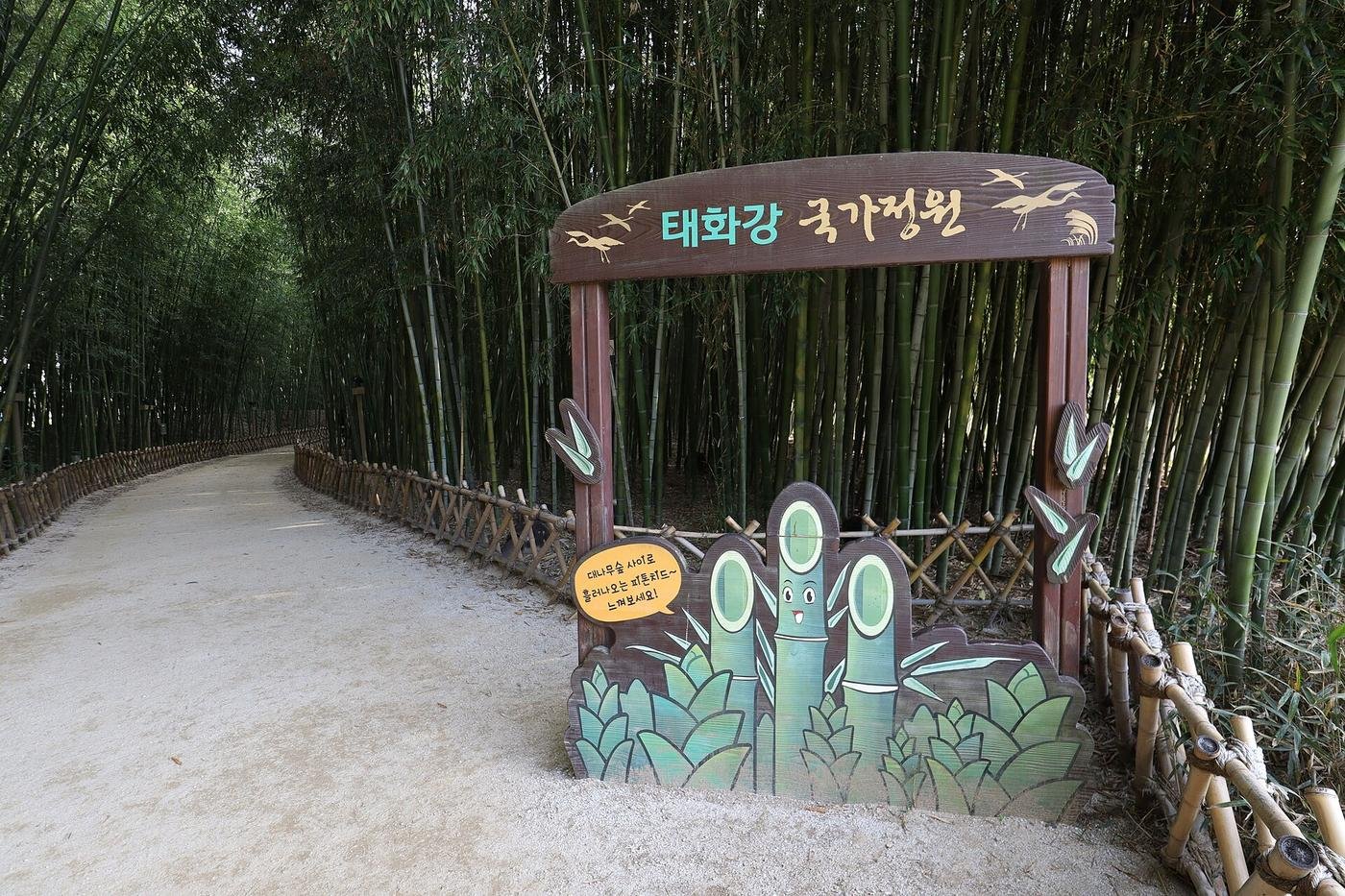
Taehwagang National Garden in Ulsan costs nothing to enter and never closes: it is open 24 hours a day, every day of the year, and there are no gates or ticket booths. You can step in from almost any point along the riverbank. Designated Korea’s second national garden in July 2019, it covers 835,452㎡ on both banks of the Taehwagang River, right in the middle of the city.
The highlight is Simnidaesup, a bamboo grove that runs for about 4 km along the water. After sunset, a 600 m stretch inside the grove called Eunhasu-gil, or the Milky Way Trail, is lit until 23:00. If you arrive by KTX, take city bus 523, 1733, 5001, 5003 or 5004 from KTX Ulsan Station and get off at the stop named “Taehwagang National Garden / Donggang Hospital.”
| Item | Details |
|---|---|
| Admission | Free |
| Hours | Open 24 hours, year-round |
| Info Center | 09:00–18:00, 5 Saetgangnam-gil, Jung-gu, Ulsan, +82-52-229-3147 |
| Milky Way Trail | 600 m lit path inside the bamboo grove, sunset to 23:00 |
| Simni Bamboo Grove | About 4 km, 109,866㎡, about 500,000 bamboo |
| Eunhasu Bridge | Pedestrian bridge about 520 m long, 3 m wide, opened 25 June 2020 (2020 news report) |
| Parking | 14 public lots, 3 free; paid rate per VisitKorea KRW 500 for 30 minutes |
| Wheelchair and stroller loans | 10:00–16:50, ID required |
Do you need a ticket, and when is Taehwagang National Garden open?
You do not need a ticket at all. The garden is free and open around the clock, every day, with no fences or entry points you have to pass through. The only part with set hours is the Info Center, which runs from 09:00 to 18:00.
That makes the garden unusually flexible for travelers. You can walk through it early in the morning before catching a train, come by after dinner, or drop in between other stops in Ulsan without planning around opening times. The official garden FAQ confirms the free entry, the 24-hour access and the trail lighting hours in one place. If you want a paper map or have questions, visit the Info Center at 5 Saetgangnam-gil, Jung-gu, during its opening hours, or call +82-52-229-3147.
What makes it a “national garden”?
Taehwagang became the country’s second one in July 2019. The garden stretches across two districts: the Taehwa area in Jung-gu on the north bank and the Samho area in Nam-gu on the south bank. Inside, it is divided into themed sections for ecology, bamboo, seasonal flowers, aquatic plants, hands-on participation and mugunghwa, Korea’s national flower.
The story behind it is part of the appeal. The Taehwagang River was badly polluted during Ulsan’s rapid industrialization in the 1960s. Today the official site describes it as clean water again, along the full 47.54 km of the river. Egrets gather here in summer, huge flocks of rooks arrive in winter, and otters and returning salmon have been recorded. If you enjoy birdwatching, keep an eye on the treetops near the grove at dusk.
Can you join a guided tour?
The garden offers interpreter-led walks, classes and space rentals, which are booked through Ulsan’s public reservation site, yes.ulsan.go.kr. You have to sign up for an Ulsan integrated membership before you can reserve, so if you are traveling as a group and want a guide, set that up well before your visit rather than on the day.
How should you plan a walk through Simni Bamboo Grove and the Milky Way Trail?
The easiest plan is to arrive in the late afternoon, walk the bamboo grove in daylight, and then stay for the Milky Way Trail once the sun has gone down. The grove itself is about 4 km long, covers 109,866㎡ and holds roughly 500,000 bamboo. The lit section is only 600 m, so you can enjoy both versions of the same path in a single evening.
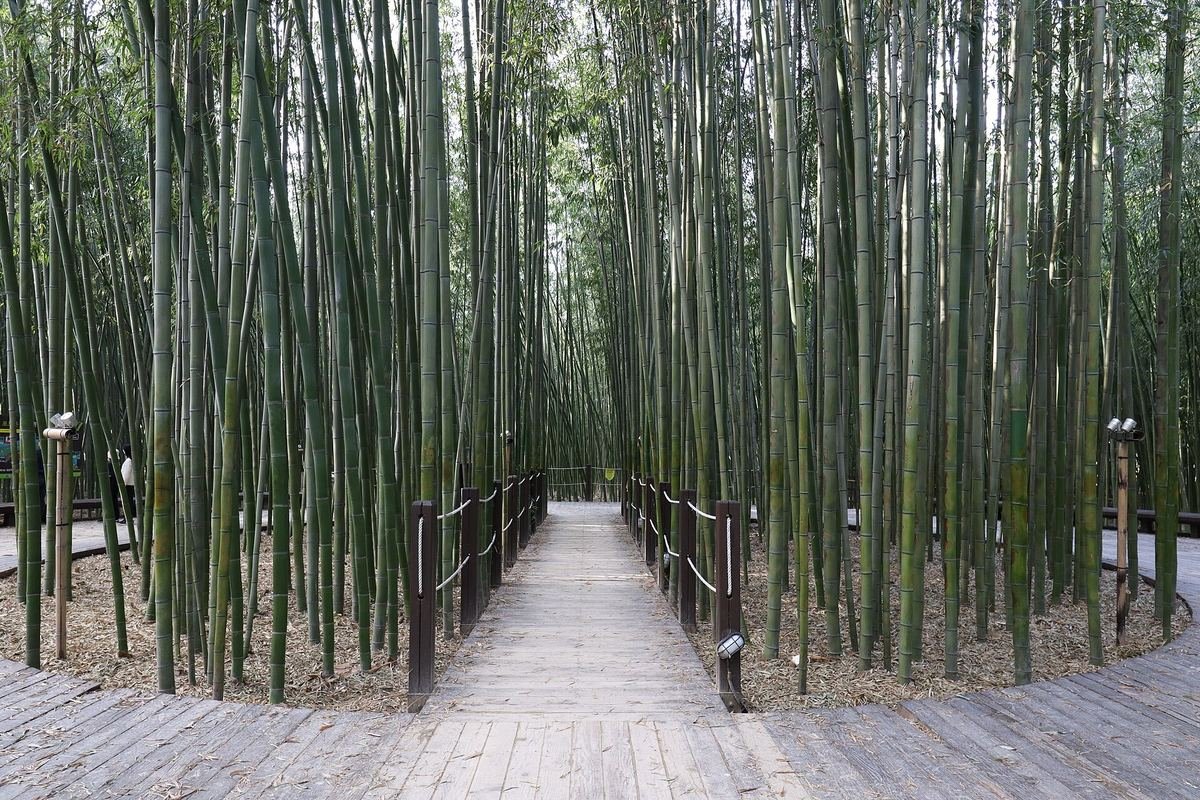
A boardwalk through Simni Bamboo Grove. Photo: Mobius6, CC BY-SA 4.0, Wikimedia Commons
Where does the bamboo grove come from?
The name Simni means “ten ri,” an old Korean unit of distance, which is where the roughly 4 km length comes from. According to official guidance, the grove grew naturally rather than being planted, and it already appears in Hakseongji, a local gazetteer written in 1749. The official FAQ also calls it the largest bamboo forest in Korea. VisitKorea notes that the grove was once nearly cleared as part of flood-control work and survived because local residents pushed to keep it. In 2017 it was named an Accessible Tourism Site, which is good news for anyone traveling with limited mobility.
Along the paths you will find small interactive spots, including a bamboo xylophone and a board where visitors leave messages. Fans of Korean drama may also recognize the area: VisitKorea lists the garden as a filming location for Death’s Game.
When do the Milky Way Trail lights come on?
The lights switch on automatically at sunset and stay on until 23:00 every night. Because the start time follows the actual sunset, it shifts through the year, earlier in winter and later in summer. Check the sunset time for Ulsan on your weather app that day, then plan to be at the trail a little before it.
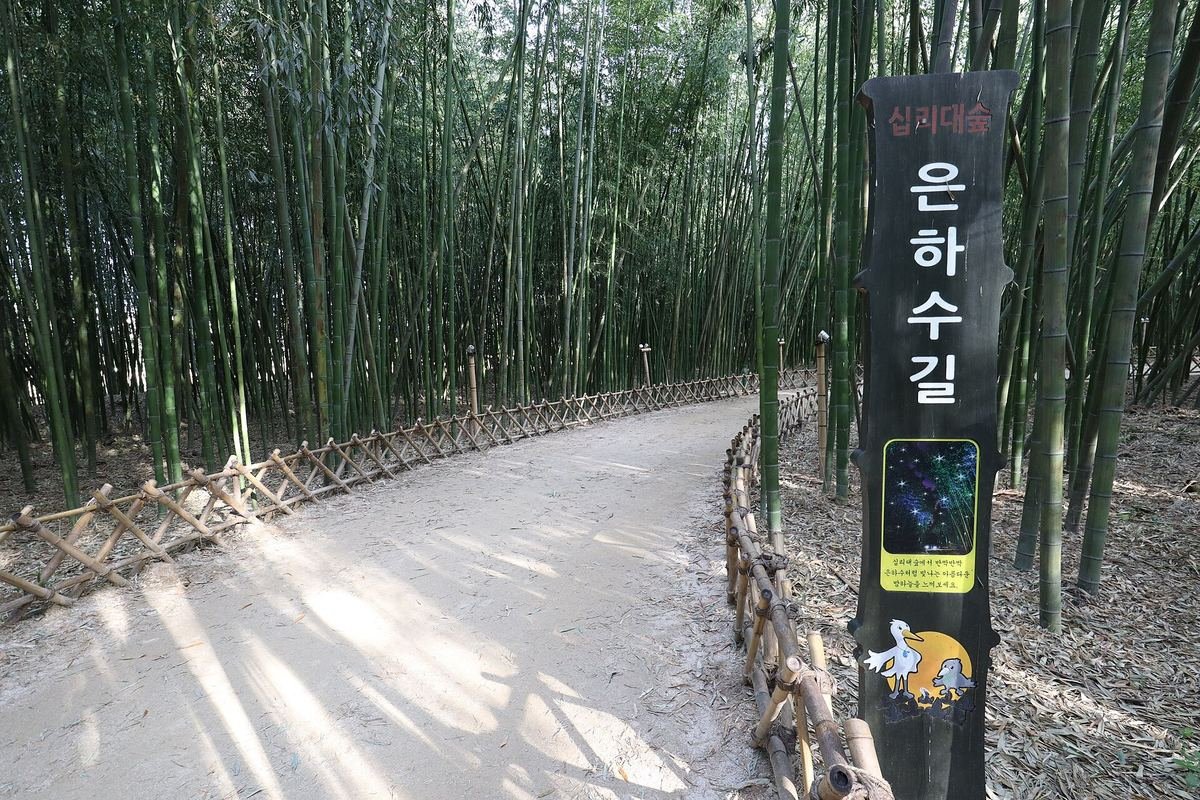
Daytime view of the Eunhasu-gil (Milky Way Trail) sign in the grove. Photo: Mobius6, CC BY-SA 4.0, Wikimedia Commons
Is the Milky Way Trail the same as Eunhasu Bridge?
No. The two names are easy to mix up. The Milky Way Trail (Eunhasu-gil) is the 600 m lit walking path inside the bamboo grove. Eunhasu Bridge (Eunhasu-dari) is a pedestrian bridge over the river, and both names share the Korean word for the Milky Way.
According to a 2020 Yonhap News report, the bridge hangs beneath the Gukgajeongwon-gyo road bridge, is about 520 m long and 3 m wide, and first opened on 25 June 2020. It links the Taehwa area in Jung-gu with the Samho area in Nam-gu, so it is the handiest way to walk from one half of the garden to the other. Crossing it gives you wide views of the river and both banks in one go.
The bridge has its own lighting, but its hours are not confirmed to match the trail’s sunset-to-23:00 schedule. If seeing the bridge at night is part of your plan, ask at the Info Center or check the signs on site before you go.
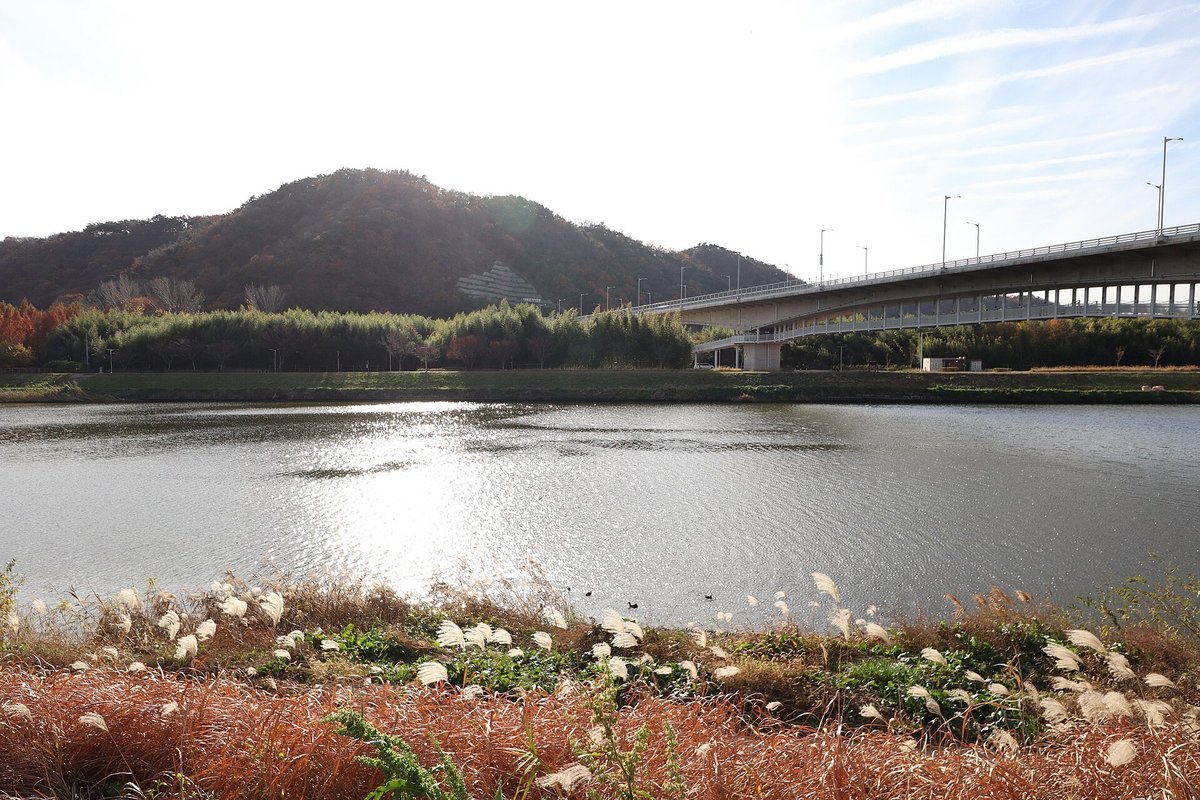
The Taehwagang River and a bridge in late autumn. Photo: Mobius6, CC BY-SA 4.0, Wikimedia Commons
What else is within walking distance?
Several sights sit close to the garden, so you can build a half day around it. Taehwaru Pavilion (+82-52-211-0888) is a traditional pavilion overlooking the river. Donggulpia (+82-52-226-0077) is a cave attraction on the south side. The Migratory Bird Center (+82-52-226-1963) has VR and 5D exhibits about the birds that visit the river. Taehwagang Observatory (+82-52-229-7579) has a café that rotates a full 360 degrees, so you see the whole river while you sit. If you also want coastal scenery in Ulsan, our Ulsan Daewangam Park guide covers the city’s best-known seaside walk.
How do you get there from KTX Ulsan Station, the bus terminal or the airport?
Whichever way you arrive, the plan is the same: take a city bus and get off at the “Taehwagang National Garden / Donggang Hospital” stop. The route numbers below follow the official directions page, last updated on 30 July 2026. Routes can change, so treat them as a starting point and confirm in a map app.
From KTX Ulsan Station, which is where most high-speed trains from Seoul stop, take bus 523, 1733, 5001, 5003 or 5004. From Taehwagang Station, served by regular trains, take bus 523, 713, 763, 1115, 1733 or 9001. From the intercity and express bus terminal, take bus 417, 523, 713, 723, 763, 1115, 1733 or 9001. From Ulsan Airport, take bus 213, 422, 462 or 1224.
Journey times, fares and how often buses run are not listed on the official page, and the same goes for taxi fares. Before you set out, look up the route in Kakao Map or Naver Map — both are linked from the official directions page, and they are the apps most locals use for bus routes.
What if you drive?
There are 14 public parking lots around the garden. Three of them are free: Taehwagang Observatory (28 spaces), Samho Riverside (175 spaces) and Donggulpia (55 spaces). Larger paid lots include Annex Lot 1 with 215 spaces, which also takes coaches, and Annex Lot 2 with 447 spaces. VisitKorea lists the paid rate as KRW 500 for the first 30 minutes, KRW 200 for each extra 10 minutes and a daily maximum of KRW 10,000, though individual lots may differ. Some lots settle payment by smartphone or at card-only machines, so carry a card. For parking questions, call the parking control center at +82-52-229-3146.
Is the garden easy to visit with a wheelchair, a stroller or a picnic?
Yes. Every part of the garden can be reached by wheelchair or stroller, although a few unpaved stretches may be closed after heavy rain. Wheelchairs and strollers can be borrowed at the on-site guide booths from 10:00 to 16:50 every day. You must leave an ID while you use one, so international visitors should bring a passport.
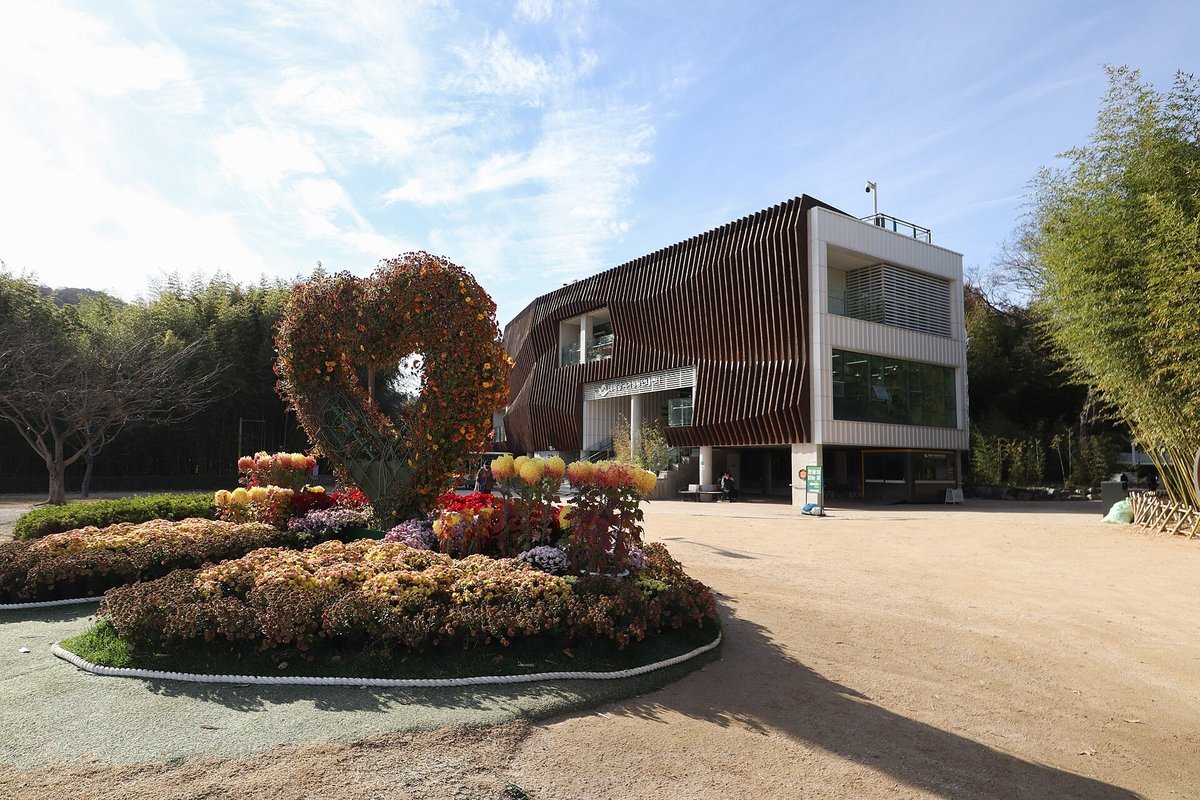
A heart-shaped flower sculpture and a building in the garden. Photo: Mobius6, CC BY-SA 4.0, Wikimedia Commons
Where can you set up a tent or shade?
Picnics are welcome, but tents and sunshades are allowed only on the Sopung-madang picnic lawn. Shades must be no larger than 2 m × 2 m, you cannot drive pegs into the ground, and setting up is permitted only between 09:00 and 18:00. Packing a light pop-up shade or a simple mat is the easiest way to follow the rules.
Who can help if you get stuck?
The 1330 Korea Travel Helpline runs 24 hours a day. Dial 1330 inside Korea or +82-2-1330 from abroad, then press 2 for English. Through the VisitKorea app you can also call it free over Wi-Fi, and operators can connect you to emergency services if needed. It is useful for checking a bus route, asking a taxi driver a question or getting help at a ticket machine.
Frequently asked questions
Q. How much does it cost to enter Taehwagang National Garden?
A. Nothing. The garden is free and open 24 hours a day, year-round. Only the Info Center keeps set hours, 09:00 to 18:00.
Q. What time is the Milky Way Trail lit?
A. From sunset until 23:00 every day. It is the 600 m stretch inside the bamboo grove, not the Eunhasu Bridge over the river.
Q. Which bus goes from KTX Ulsan Station to the garden?
A. Take bus 523, 1733, 5001, 5003 or 5004 and get off at “Taehwagang National Garden / Donggang Hospital.”
Q. Is there free parking?
A. Yes. Three of the 14 public lots are free: Taehwagang Observatory, Samho Riverside and Donggulpia. Paid lots charge KRW 500 for 30 minutes per VisitKorea, up to KRW 10,000 a day.
Sources
- Taehwagang National Garden — official FAQ (free entry, hours, Milky Way Trail, bamboo grove, loans, tent rules)
- Taehwagang National Garden — official directions (address, parking, bus routes; updated 30 July 2026)
- VisitKorea — Taehwagang National Garden (parking rates, designation)
- Ulsan Tour — Eco Tour (nearby sights, Accessible Tourism Site)
- Yonhap News (23 Oct 2020) — Eunhasu Bridge length, width and opening date
- VisitKorea — 1330 Korea Travel Helpline
- Featured photo: wooden arch sign at a bamboo-grove path, Mobius6, CC BY-SA 4.0, Wikimedia Commons (taken 25 Nov 2022)
Leave a Reply