
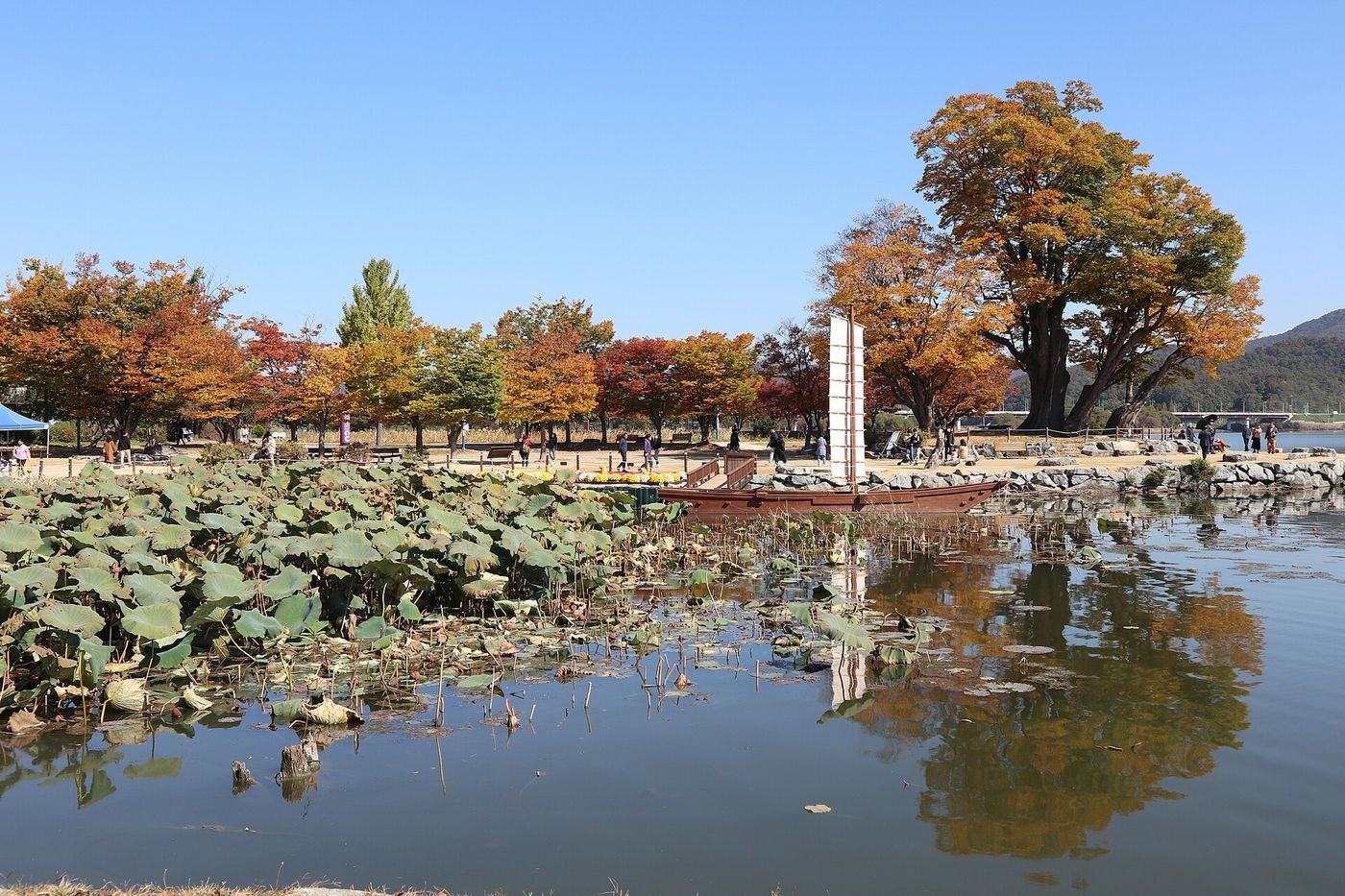
Dumulmeori is the riverside point in Yangpyeong, just east of Seoul, where the Bukhangang (North Han) and Namhangang (South Han) rivers join to become the Han River. It is an open-air spot with no ticket booth, so admission is free, and VisitKorea lists it as open 24 hours a day, all year. Right next to it sits Semiwon, a paid water-and-flower garden that opens 09:00–18:00 with last entry at 17:30. An adult ticket costs ₩7,000, and you receive a ₩2,000 Yangpyeong local gift voucher back when you pay.
The two places are connected by a pontoon bridge made of 44 boats, about 200 m long, so you can see both in one easy half day. By public transport, ride the Gyeongui-Jungang Line of the Seoul subway network to Yangsu Station; Semiwon is about 700 m from the station. One timing note for autumn travelers: October is the last month Semiwon opens every day. From November it closes on Mondays.
What is Dumulmeori, and why do people travel out to see it?
The name means “the place where two waters put their heads together.” The North Han flows down from the Geumgangsan area, the South Han starts at the Geomnyongso spring, and they merge here into the single river that later runs through Seoul. There is no entrance fee and no gate, which makes it one of the easiest nature stops around the capital.
According to the Yangpyeong County tourism page for Dumulmeori, the site has been picked for the Korea Tourism Organization’s “100 Must-Visit Tourist Spots” list seven times in a row, and the county says Yangpyeong was named a 2026 UN Tourism Best Tourism Village. Those labels explain the weekend crowds, but the appeal is simple: wide, calm water, mountains on the far bank, and a long flat shoreline you can wander without any planning. If you have questions on the day, the Dumulmeori tourist information center answers at +82-31-775-8700, and the national 1330 Korea Travel Hotline (+82-2-1330) can help in English.
The 400-year-old zelkova and the hwangpo sailboat
The landmark everyone photographs is a single zelkova tree on the bank. It stands 26 m tall and is more than 400 years old. It once served as the village guardian tree, and the county notes that it used to have a twin; the second tree was submerged when Paldang Dam was completed in 1972, which raised the water level. Standing under it, you can still sense how much the shoreline changed.
In front of the tree you will usually see a hwangpo sailboat, a traditional wooden boat with a reddish-brown sail. It is 16 m long and 3 m wide with an 8 m mast, and it was restored by a master boatbuilder recognized as an intangible cultural heritage holder by Gyeonggi Province. Treat it as a moored display rather than a ride; it mostly stays tied up at the bank.
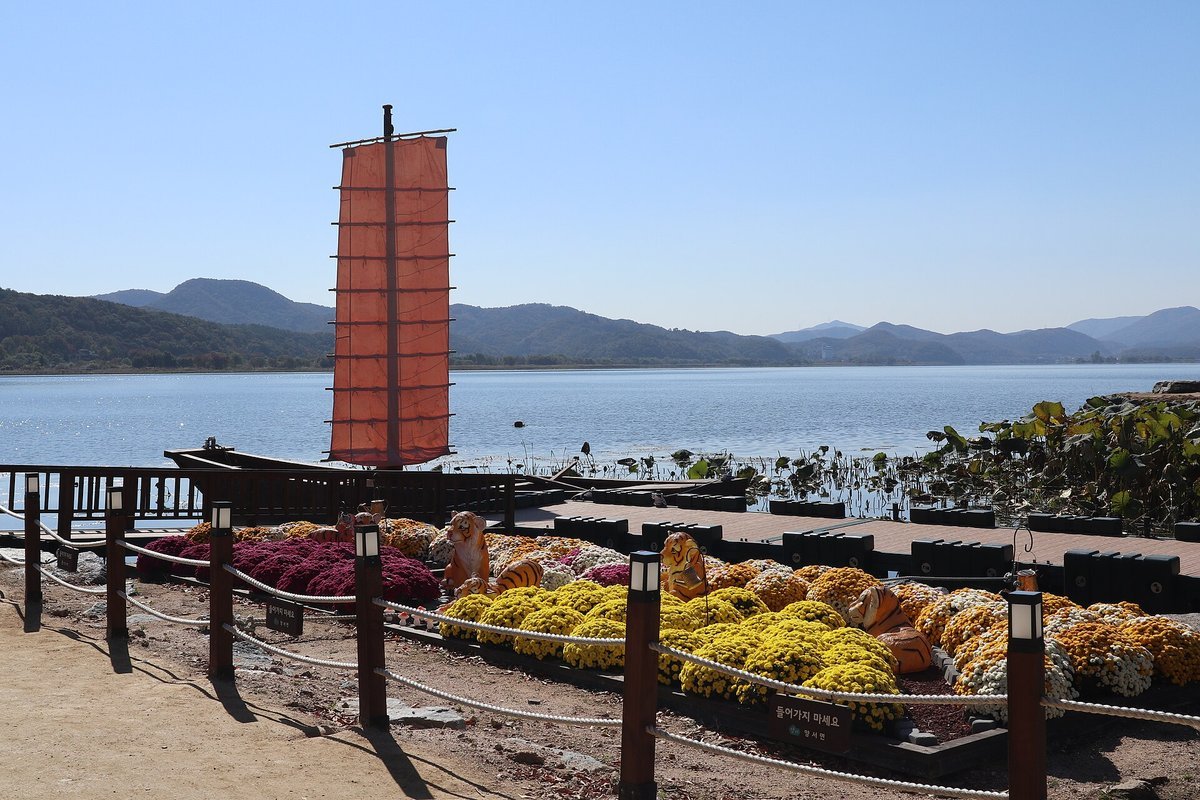
A hwangpo sailboat moored on the Dumulmeori riverbank beside the walking path (October 2022). Photo: S h y numis, CC BY-SA 4.0, Wikimedia Commons.
Other corners of the riverbank
Walking along the shore, you pass a Wish Rest Area, a Reed Rest Area, a Mist Rest Area and the site of the old ferry landing. The very tip where the two rivers meet is called Dumulgyeong. You can reach it on a wooden deck or a dirt path, and you will find a marker stone and an old map set into the ground. Locals know Dumulgyeong for sunsets and for snowy winter views, so it is worth the extra few minutes of walking.
How much is Semiwon, and when is it open?
Semiwon is open 09:00–18:00, and tickets are sold until 17:30. Adults aged 19 and over pay ₩7,000 and get a ₩2,000 Yangpyeong local gift voucher back, which you can spend at participating shops in the county. From April to October it opens every day; from November to March it closes on Mondays, and if a Monday is a public holiday it closes the following day instead.
The table below follows the official Semiwon visitor guide.
| Ticket type | Who it covers | Price | Voucher returned |
|---|---|---|---|
| General | Adults 19+ | ₩7,000 | ₩2,000 |
| Discount | Ages 6+ children and teens, seniors 65+, visitors with mild disabilities | ₩4,000 | ₩1,000 |
| Group | 30 people or more (no double discounts) | ₩4,000 | ₩1,000 |
| Free | Age 5 and under, Yangpyeong residents, visitors with severe disabilities plus one companion, and other listed groups | ₩0 | None |
For most foreign visitors the general or discount ticket will apply. The free categories for residents and certain national groups require Korean ID or documents, so plan to pay the standard price unless you are traveling with a child aged 5 or under.
What you cannot bring into Semiwon
The garden has a short list of banned items, and staff do enforce it. Pets are not allowed, although service dogs are welcome. Food of any kind is not allowed inside; drinks are fine. Bicycles, kick scooters, drones, tents and balls must stay outside too. If you packed a picnic, eat it on the open Dumulmeori side before or after your garden visit. If you are a drone hobbyist hoping for an aerial shot of the river junction, leave that idea at home for this trip.
Highlights inside the garden
Semiwon covers 127,085 m² and grows about 270 plant species, with a strong focus on water plants. In June 2019 it became Gyeonggi Province’s first designated provincial garden. Inside you will find a Lotus Museum devoted entirely to the lotus, the Jangdokdae fountain built among traditional earthenware jars, a Love Pond inspired by Monet’s water-lily garden, Sehanjeong (based on the famous “Sehando” ink painting by the scholar Kim Jeong-hui) and a World Water Lily House. The garden even developed its own water-lily cultivar, “Semi No. 1,” which was registered with the national seed agency on February 13, 2022.
Bloom times matter if flowers are your main reason to come. The big lotus ponds peak from late June to early August, the giant Victoria water lilies flower in July and August, and the tropical water lilies keep blooming from July into October. So an October visit will not show you the summer lotus sea, but the tropical water lilies can still be in flower. The 2026 summer lotus festival, which ran from June 26 to August 17 according to press reports, has already ended.
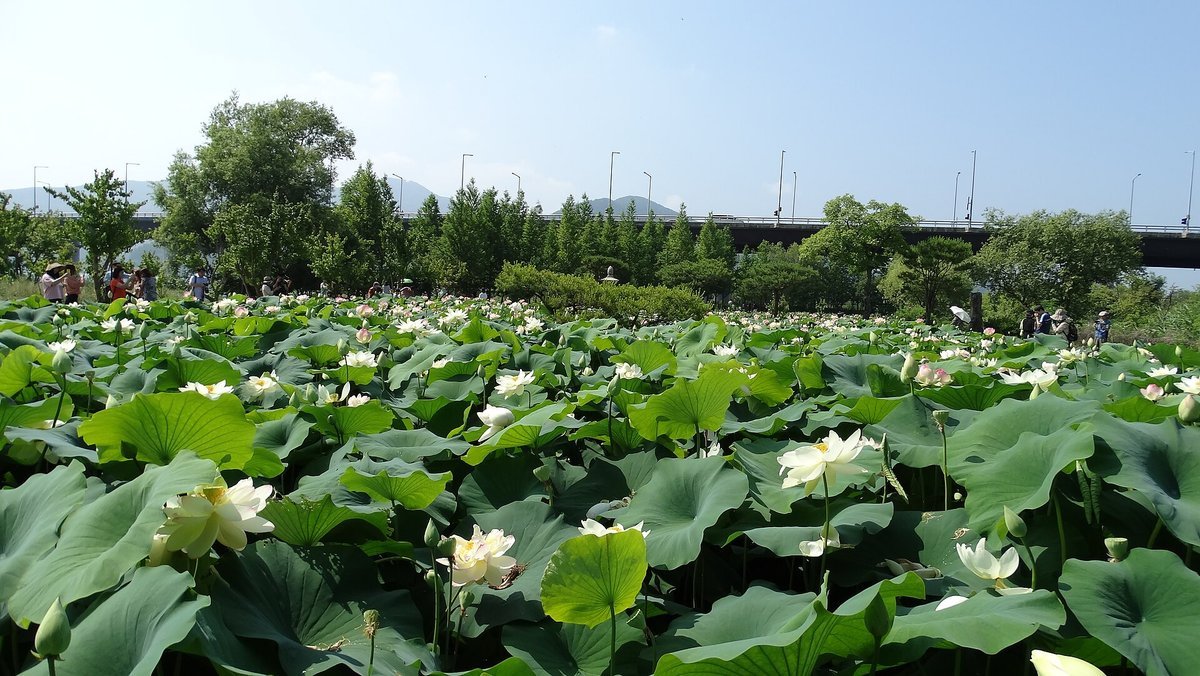
Lotus leaves and white lotus blossoms covering a Semiwon pond in summer (June 2015). Photo: Jocelyndurrey, CC BY-SA 4.0, Wikimedia Commons.
Can you walk between Semiwon and Dumulmeori on the pontoon bridge?
Yes. The Baedari pontoon bridge links Semiwon with the Dumulmeori side, so a single loop covers both. It reopened in 2024 and is made of 44 traditional-style boats joined in a staggered line, about 200 m in total. The design recreates the boat bridge King Jeongjo of the Joseon dynasty used to cross the Han River on his royal processions.
Semiwon’s own recommended route starts at the Burimun ticket gate and takes about an hour on average. It passes the Lotus Museum, the Jangdokdae fountain, the lotus ponds, the Love Pond and Sehanjeong, then crosses the bridge to Sangchunwon and Dumulmeori before coming back over the bridge to finish at the tropical water lily pond, the Yusanggoksu water channel, the Victoria pond and the red lotus pond. The official pages do not say whether your ticket is checked on the bridge, so follow the on-site signs and staff directions, and keep your ticket with you until you are back on the garden side.
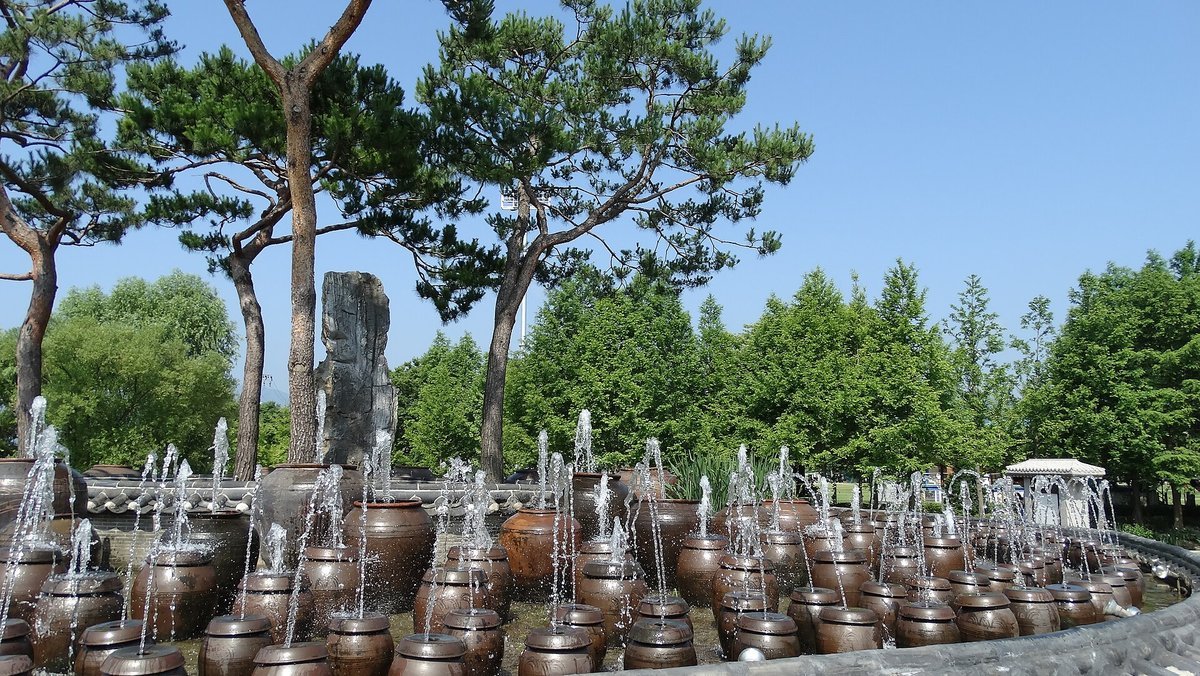
The Jangdokdae fountain among earthenware jars at Semiwon (June 2015). Photo: Jocelyndurrey, CC BY-SA 4.0, Wikimedia Commons.
How do you get to Dumulmeori from Seoul without a car?
Take the Gyeongui-Jungang Line, part of the Seoul Metropolitan Subway network, to Yangsu Station. Semiwon is about 700 m from the station, an easy walk. Dumulmeori itself is about 20 to 30 minutes on foot from Exit 1 if you head straight toward the river, according to Korea Tourism Organization data.
If you prefer a direct bus from Seoul, the Korea Tourism Organization accessible travel page for Semiwon lists bus 2000-1 from Gangbyeon Station and bus 2000-2 from Jamsil Station. Both stop at “Semiwon,” about 100 m from the entrance. Bus 167 from Cheongnyangni stops at Yangsu Bridge Entrance, about 500 m away, and express bus G9311 stops at Yangsu Police Box, about 600 m away. Journey times from central Seoul depend heavily on traffic and train connections, so check a map app such as Naver Map or Kakao Map on the morning you travel.
Local buses and taxis from Yangsu Station
VisitKorea’s English travel magazine explains that buses 8-4, 8-5, 8-7, 8-8, 8-55 and 88-6 leave from the stop across from Exit 1, next to the convenience store. Get off at “Yangseo-myeon Office” for a walk of about three minutes to Semiwon, or at “Yangsu-ri Dumulmeori” for a walk of about 20 minutes to the riverbank. A taxi from the station takes about five minutes to Semiwon and about ten minutes to Dumulmeori. Local routes can change, so confirm the number on the bus before you board.
Driving and parking
If you rent a car, Semiwon’s parking is free: small cars use the Yangseo Culture and Sports Park lot, and large vehicles use the Yangseo Library lot. There is also a paid parking lot near Dumulmeori. Roads around Yangsu-ri get congested on weekends and holidays, so the train is usually the calmer choice.
When is the best time for the morning mist and the famous photo frame?
Come early. The river mist is thickest just after dawn and lingers longest on days with a big gap between night and daytime temperatures, which is common in autumn. Because Dumulmeori never closes, photographers often arrive before sunrise and wait by the water with tripods.
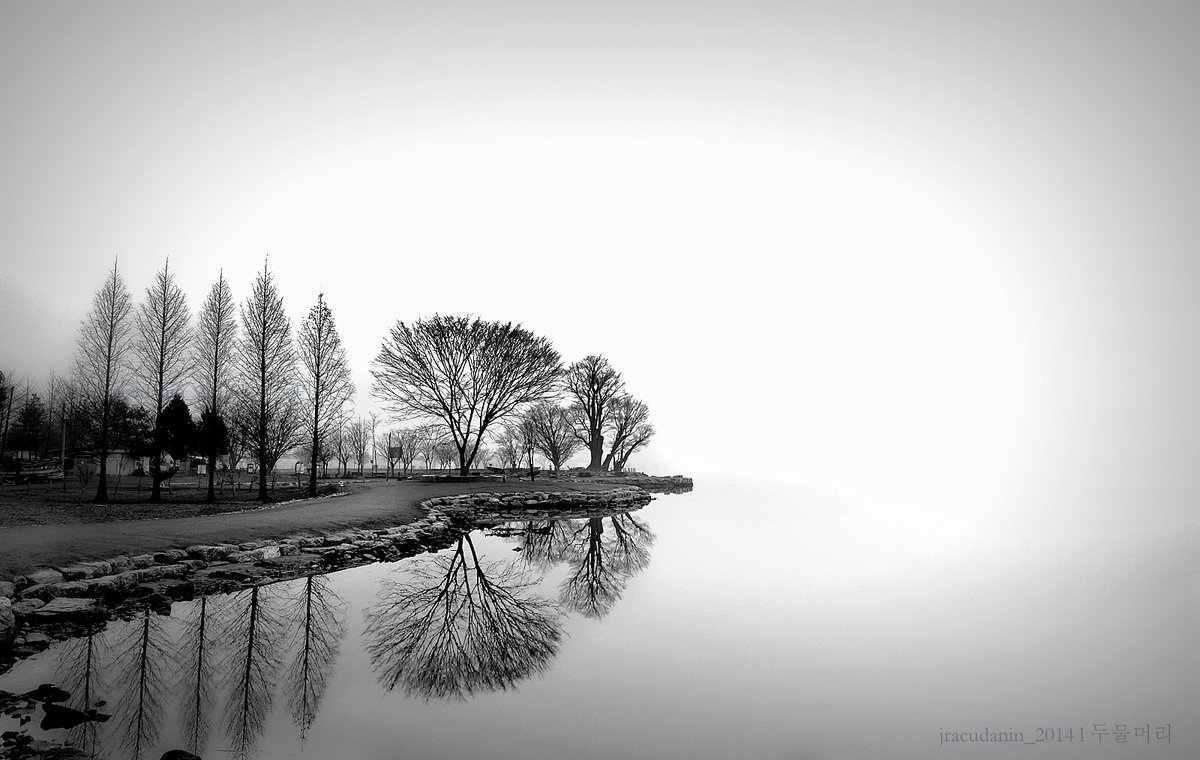
Riverside trees at Dumulmeori in early-morning mist (black-and-white). Photo: Rhie Cudanin, CC BY 3.0, Wikimedia Commons.
The picture-frame photo spot
The most popular photo stop is a large wooden picture frame set up facing the river, built along with the Wish Rest Area during riverside works in 2013. It became famous after appearing in the 2015 Korean drama “She Was Pretty,” and on weekend afternoons there can be a queue. Stand so the frame holds the water and the mountains across the river, and visit early in the morning if you want the shot without strangers in it.
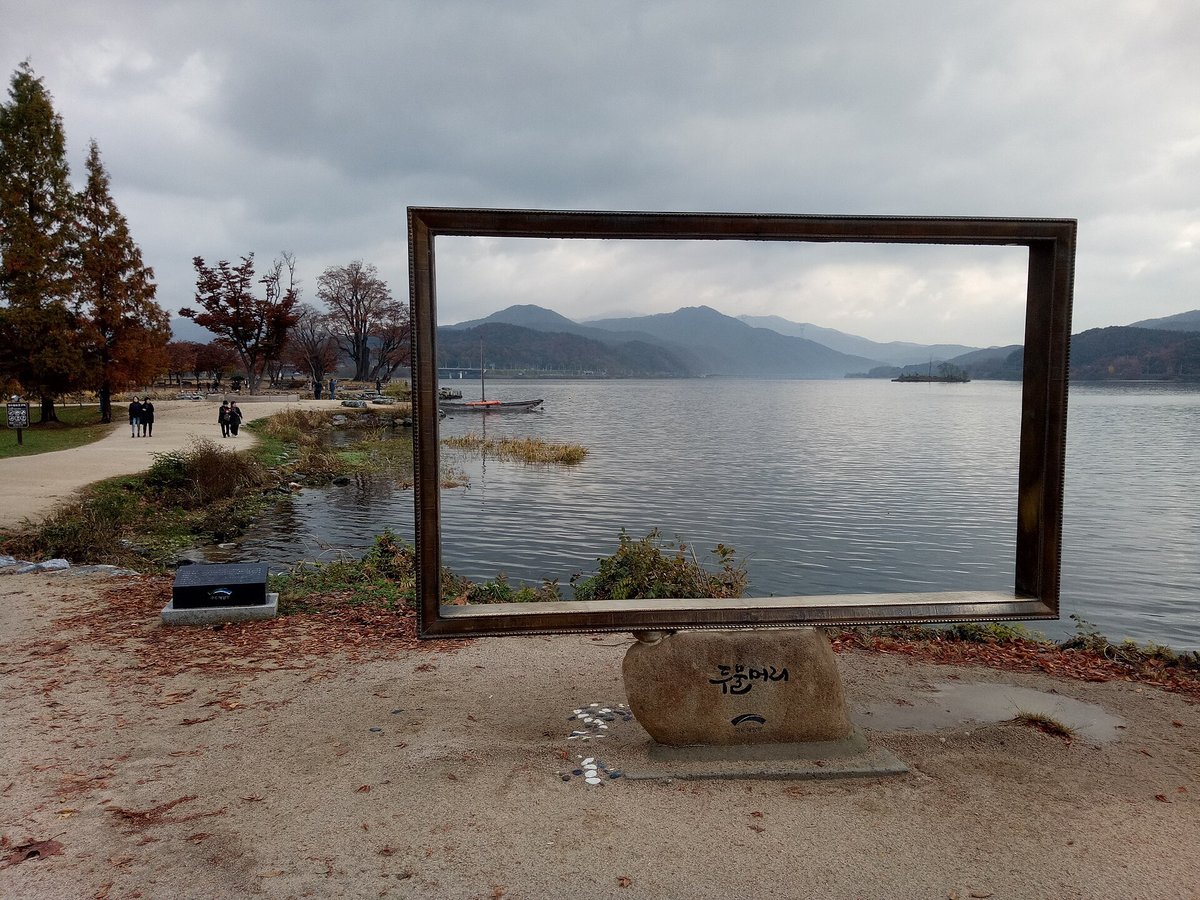
The wooden picture-frame photo spot with the river and mountains behind it (November 2019). Photo: Foxy1219, CC BY-SA 4.0, Wikimedia Commons.
Easy walks, accessibility and a second stop
The Dumulmeori Mullae trail is a flat riverside path linking Yangseo Culture and Sports Park, Semiwon and an eco-park flower trail. Think of it as a stroll, not a hike, which makes it comfortable for children and older travelers. Semiwon has a step-free main entrance, lends five wheelchairs and five strollers in exchange for an ID deposit, and has a nursing room, an elevator in the Lotus Museum and an accessible toilet by the ticket office. On the riverbank, a stand selling a green lotus-leaf hotdog is a well-known snack stop. If you still have energy, the free Namyangju Water Garden, also on the Gyeongui-Jungang Line and about ten minutes’ walk from Ungilsan Station Exit 1, pairs nicely with this trip. For more ideas, see our Ganghwa Island day trip guide or our Seoul Botanic Park guide.
FAQ
Q. Is Dumulmeori free, and can I visit at night?
A. Yes. Dumulmeori is an open-air riverside area with no admission fee, and VisitKorea lists it as open 24 hours, all year. Many photographers arrive before sunrise for the mist.
Q. How much is Semiwon, and how much do I get back as a voucher?
A. Adults pay ₩7,000 and receive a ₩2,000 Yangpyeong gift voucher. Discount tickets and groups of 30 or more pay ₩4,000 with a ₩1,000 voucher. Children aged 5 and under enter free.
Q. What are Semiwon’s hours, and does it close on any day?
A. Semiwon is open 09:00–18:00 with last entry at 17:30. It opens daily from April to October and closes on Mondays from November to March (the next day if Monday is a holiday).
Q. How far is it from Yangsu Station to Semiwon and Dumulmeori?
A. Semiwon is about 700 m from Yangsu Station. Walking from Exit 1 to Dumulmeori takes about 20 to 30 minutes, and a taxi takes about five minutes to Semiwon or ten minutes to Dumulmeori.
Sources
- Semiwon — visitor guide (hours, closures, fees, banned items)
- Semiwon — overview (area, plants, pontoon bridge)
- Semiwon — facilities, recommended route, bloom times
- Yangpyeong Tourism — Dumulmeori
- Yangpyeong Tourism — Semiwon (parking)
- VisitKorea — Dumulmeori
- VisitKorea — Semiwon (parking lots)
- Korea Tourism Organization accessible travel — Semiwon
- VisitKorea magazine — buses and taxis from Yangsu Station, Namyangju Water Garden
- Gyeonggi Tourism — Dumulmeori Mullae trail
- Featured photo: zelkova tree reflected in a pond at Dumulmeori (October 2022), S h y numis, CC BY-SA 4.0, Wikimedia Commons
Leave a Reply