
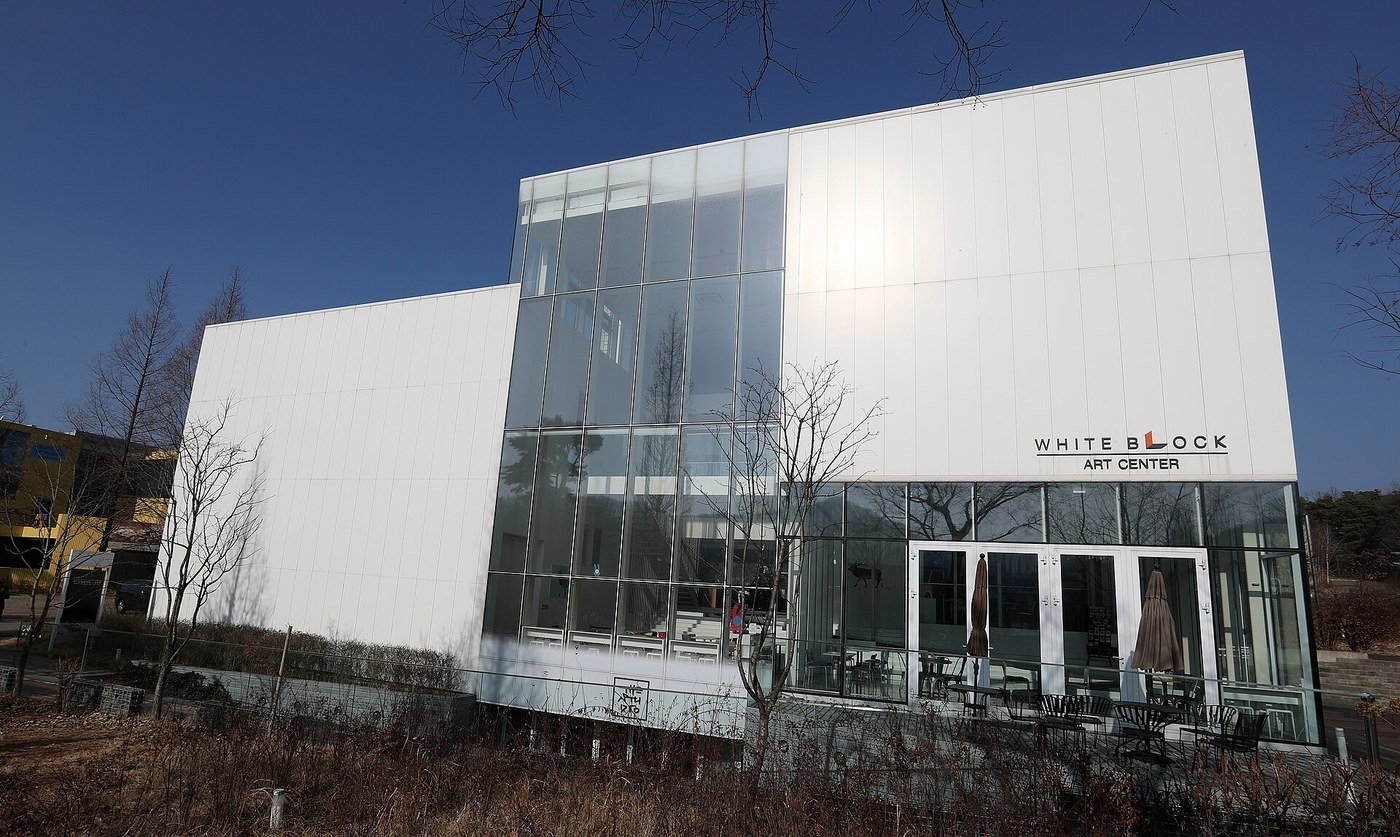
Heyri Art Village in Paju, north-west of Seoul, is an open-air arts district with no walls, gates that never close and no entry ticket. You can walk in at any hour, on any day of the year, for free. What you pay for are the individual galleries, museums and craft workshops inside, each of which sets its own admission and opening hours.
The easiest way there from Seoul is Bus 2200 from Hongik University Station Exit 1 or Hapjeong Station Exit 1, which takes about 45–50 minutes and runs every 10–15 minutes. Two things matter more than anything else when you plan: avoid Mondays, when most exhibition spaces and many cafés close, and remember that the only official ticket booth is the one in front of Gate 4.
What is Heyri, and do you need a ticket to get in?
You do not need a ticket to enter Heyri. The village itself is free and open 24 hours a day, 365 days a year, and you pay only at the venues you choose to visit. Expect an admission fee, a “culture fee” or a workshop fee at the door of each gallery or museum.
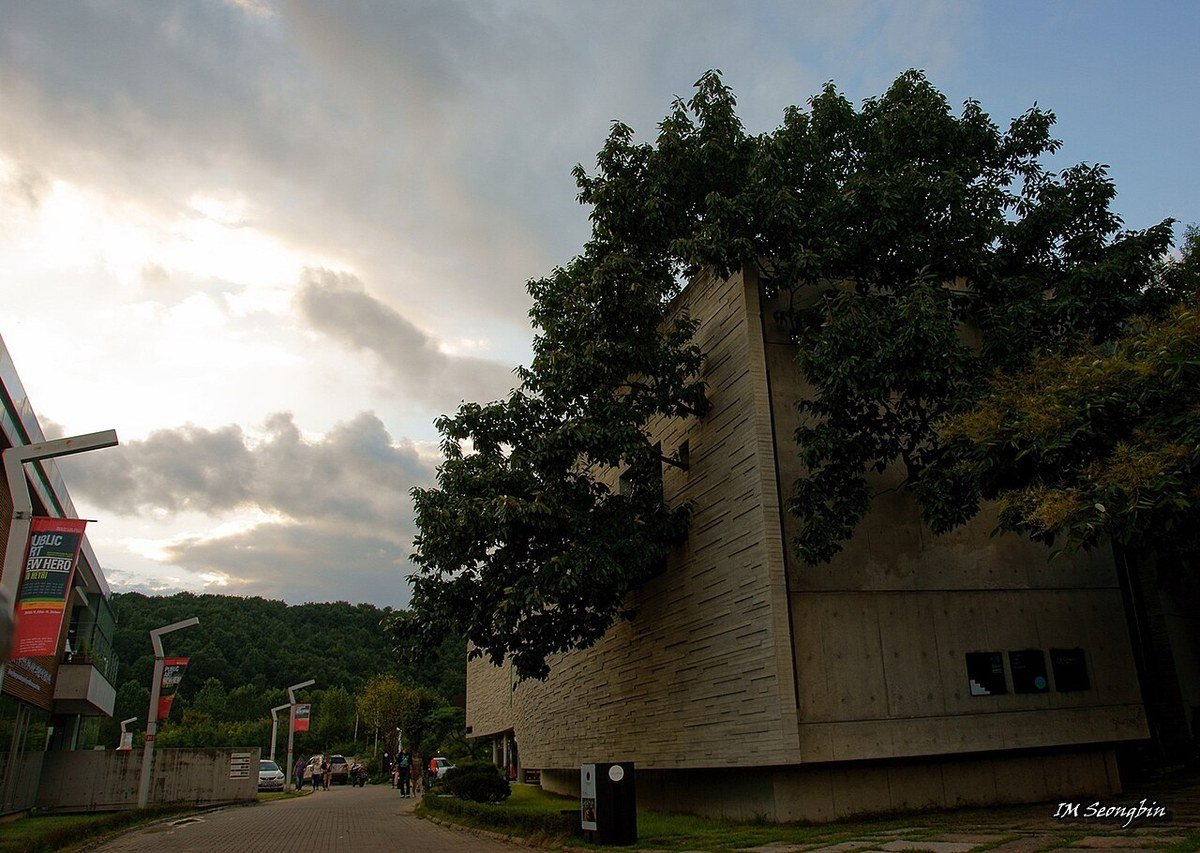
Heyri grew up in the late 1990s, when artists, writers and architects gathered here while the nearby Paju Book City was being developed. According to the Gyeonggi Tourism Organization, construction began in 1998, the village opened to the public in 2003, and it has around 380 members. The name comes from “Heyri Sound,” a traditional farming song from the Paju area. Instead of laying straight asphalt roads, the founders let the lanes follow the natural curves of the land, and the whole place was planned as a car-free village. The result feels very different from a traditional hanok neighborhood: you wander between contemporary buildings in concrete, glass and wood, and each one is its own small museum, gallery, studio or café.
That also means Heyri is not a single attraction with one entrance and one set of hours. Think of it as a neighborhood you explore at your own pace, choosing two or three venues that match your interests rather than trying to enter everything. If you would rather see a traditional village with tiled-roof houses, our Bukchon Hanok Village visiting hours guide and Jeonju Hanok Village guide cover that style of trip.
Buy tickets only at the official booth by Gate 4
The official Heyri visitor guide states that the village’s only official ticket booth stands in front of Gate 4. Any other ticket booth you see around the village is privately run. If something goes wrong with a ticket bought there, for example you want a refund or need to change a booking, the Heyri village office cannot step in and help. If you do buy from a private seller, keep the receipt and write down the seller’s phone number before you walk away, so you can contact them directly later.
A sample venue: the Money Museum (per Paju City tourism page)
To get a feel for what individual venues charge, the Money Museum is a useful example. According to the Paju City tourism page for the Money Museum, it opens 11:00–17:00 on weekdays and 11:00–18:00 on Saturdays and Sundays. Admission is KRW 2,000, or KRW 1,500 per person for groups of 30 or more. Around 3,800 items are on display, a visit takes 30 minutes or more, photography is allowed inside, and there are 10 free parking spaces. The page does not show an update date, so call the museum on 031-949-6592 before you go. For other galleries, museums and workshops, prices and hours vary by venue, so check with each venue directly.
Is Heyri worth visiting on a Monday?
Not really. The official guide says that almost all museums and exhibition spaces close on Mondays, and a good number of cafés close too. On weekends and public holidays, by contrast, nearly every venue opens, so Tuesday to Sunday is the window to aim for.
Walking around the village on a Monday is still possible, since the lanes and outdoor spaces never shut. But if the main reason for your trip is to see exhibitions, a Monday visit will feel empty. Long national holidays such as Seollal (Lunar New Year) and Chuseok are another time when some venues close, so check ahead if your trip falls in those weeks.
The official guide also shares a practical rule of thumb: if you phone a venue and nobody answers, there is a high chance it is closed that day. If there is one exhibition or workshop you really want to see, call the day before. For general questions about the village, the Heyri community center can be reached on 031-946-8551, or +82-31-946-8551 from a foreign phone.
How do you get from Seoul to Heyri by bus?
Take Bus 2200, an express bus run as a Gyeonggi public bus, from Hongik University Station Exit 1 (in front of the KDB bank) or Hapjeong Station Exit 1. The official guide gives a journey time of about 45–50 minutes, with a bus every 10–15 minutes. There is no subway or rail line to Heyri, so the express bus is the realistic public transport option.
| From | Bus | Time (official guide, approx.) | Notes |
|---|---|---|---|
| Hongik Univ. Stn Exit 1 / Hapjeong Stn Exit 1 | 2200 | about 45–50 min | Every 10–15 min; on weekends and holidays it sometimes runs as double-decker 7300 |
| Geumchon Stn (Gyeongui Line) | 900 | about 30–40 min | Stops on the opposite side of the road from the 2200 |
| Unjeong Stn | 037 | about 40 min | Alternative for Gyeongui Line riders |
Bus 2200 and the weekend double-decker 7300
Bus 2200 passes Paju Book City, Lotte Outlet and the Shinsegae Chelsea outlet on its way, which makes it easy to combine Heyri with a bookshop stop or some outlet shopping in the same day. On weekends and public holidays the service sometimes runs as Bus 7300, a double-decker that continues further north to Imjingak Pyeonghwa-Nuri Park. So if you are waiting at the stop on a Saturday and no 2200 appears, look for a bus showing 7300 as well. Fares and accepted payment methods are best checked on the Gyeonggi bus information service or at the stop before you board, and having a transit card ready saves time at the door.
Buses 900 and 037, and where to get off
If you are already on the Gyeongui Line, two local options work well. Bus 900 leaves from Geumchon Station and takes about 30–40 minutes; note that it stops on the far side of the road from where the 2200 stops, so cross carefully. Bus 037 runs from Unjeong Station and takes about 40 minutes. A bus from Daehwa Station also exists but takes over an hour, so changing at Geumchon is the better plan, and the local village buses come only every one to two hours, which is hard to plan a day around.
Near the village there are five stops, close to Gates 1, 4, 6, 8 and 10. Gates run in order from 1 to 10 along the edge of the village, so look up which gate is nearest the gallery or museum you want first, and get off at that stop. It can save you a long uphill walk.
Where can you park if you drive?
Parking at Heyri is free, there are no barriers and every gate stays open. However, because the village was designed to be car-free, spaces run short, especially on weekends and holidays. The official guide recommends public transport whenever possible.
Big lots at Gates 1 and 4, then walk
From the Jayu-ro expressway, leave at Seongdong IC, turn left at the first intersection (Seongdong) and Gate 1 appears after about 100 m. The official recommendation is to park in one of the large open lots in front of Gate 1 or Gate 4 and explore the rest of the village on foot. Many of these lots are actually vacant private plots used temporarily for parking, so a lot you used last year may have become a construction site, and it is worth arriving with a backup in mind.
Free street parking on Eoreumsil-ro
That backup is Eoreumsil-ro, the main road outside Gates 6 to 10, where Paju City runs free on-street parking. Inside the village, please do not park along the lanes: they are shared by cars and pedestrians, and parked cars block people walking. The village also notes that it is not responsible for parking or driving accidents inside its grounds, so drive slowly. Capacity is not published, so on a weekend the safest approach is simply to arrive early in the morning, or leave the car at home and take the bus.
What rules should you know, and which walks are easiest?
The whole village, outdoors included, is non-smoking because of wildfire risk. Electric scooters and other ride-on devices are banned, street stalls are not allowed, and franchise shops are largely kept out. Dogs are welcome on a leash, but each venue decides whether pets may come indoors.
These rules reflect Heyri’s status as a designated culture district, with management rules dating from 2009 that keep it a place for independent galleries and studios rather than chain stores. In practice, smokers should plan to step outside the village, and families should leave scooters in the car. Dog owners need to clean up after their pets, and dangerous breeds must wear a muzzle.
The terrain is hilly and some paving blocks are broken, so comfortable shoes help. Some of the earliest buildings have steps at the entrance or no elevator. For wheelchair users or families with strollers, the official advice is to drive right up to the venue you plan to visit and park there. There is an accessible toilet in the public restroom at Galdae (Reed) Plaza.
The Noeul Hill barrier-free forest trail
Opened in 2019, the barrier-free forest trail on Noeul Hill lets visitors with strollers and wheelchairs reach the summit. The official site mentions that North Korea can be seen from the top; how much you see depends on the weather and haze, so treat it as a possible bonus rather than a guarantee. Elsewhere, the central plaza with its pond and artworks is a vehicle-free park where performances and events are sometimes held, and the green walkway through the middle of the village and the rest area under a zelkova tree more than 500 years old are pleasant places to pause.
The Step complex and the tourist information point
The Step is a content mall made up of several halls. Halls A and B hold museums, hands-on workshops, restaurants and cafés, while Hall E houses artist residences, studios and art shops, which makes it a handy first stop on a short visit. The tourist information point has a culture and tourism guide on duty and free maps and leaflets, so picking up a map there before choosing your route is a good idea. If you enjoy colorful hillside villages, our Gamcheon Culture Village guide covers a very different arts neighborhood in Busan.
Getting help in English: the 1330 hotline
If you run into a language problem, the Korea Travel Helpline is available 24 hours a day, every day. Dial 1330 from a Korean phone with no area code, or +82-2-1330 from a foreign phone, then press 2 for English. Normal call charges apply, and you can also call free over Wi-Fi through the VisitKorea app. It is useful for checking a bus route, asking a venue a question with an interpreter’s help, or getting directions back to the bus stop.
Frequently asked questions
How much does it cost to enter Heyri Art Village?
Entering the village is free and it is open 24 hours. Each gallery or museum charges separately; the Money Museum, for example, is KRW 2,000 per the Paju City tourism page.
Can I visit Heyri on a Monday?
You can walk around, but most exhibition spaces and many cafés close on Mondays. Go between Tuesday and Sunday instead.
How long is the bus from Seoul?
Bus 2200 from Hongik Univ. or Hapjeong Station Exit 1 takes about 45–50 minutes and runs every 10–15 minutes. On weekends and holidays it sometimes runs as double-decker 7300.
Is parking free at Heyri?
Yes. The lots at Gates 1 and 4 and street parking on Eoreumsil-ro are free, but spaces run short on weekends.
Sources
- Heyri official visitor guide (gates, parking, buses, rules, closures, ticket booth)
- Paju City Culture & Tourism — Money Museum
- VisitKorea — Heyri Art Valley
- Featured photo: White Block gallery building in Heyri (January 2017), Korea.net, CC BY-SA 2.0, Wikimedia Commons
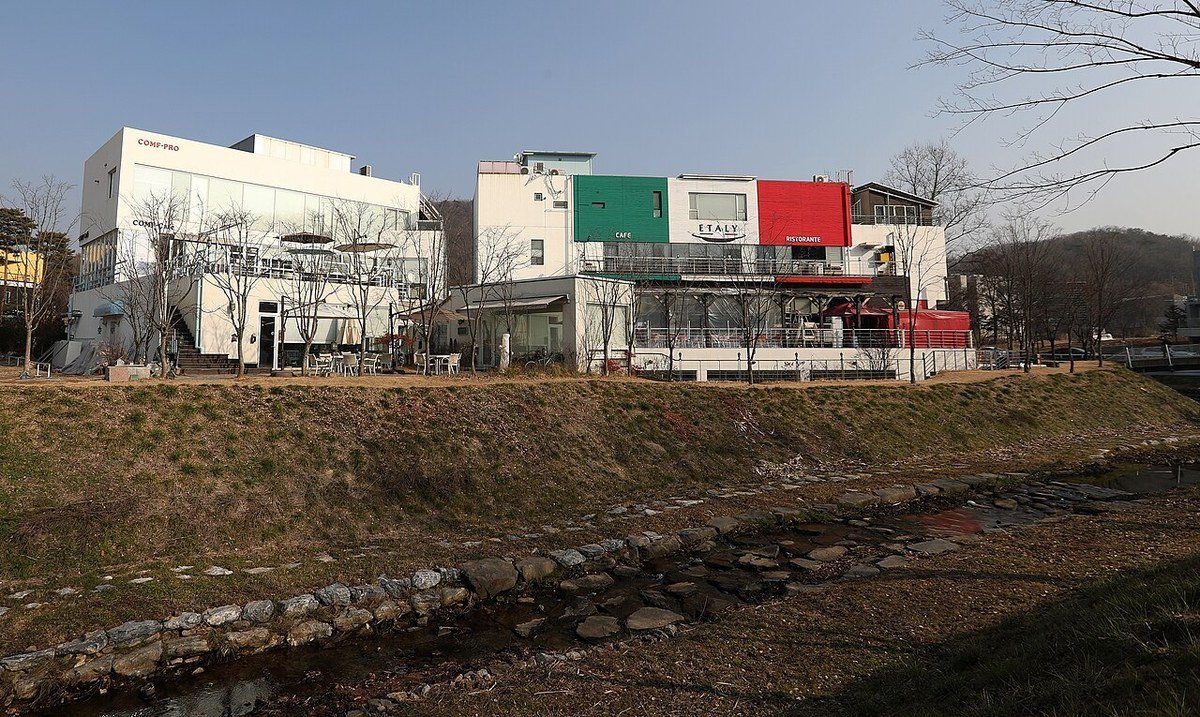
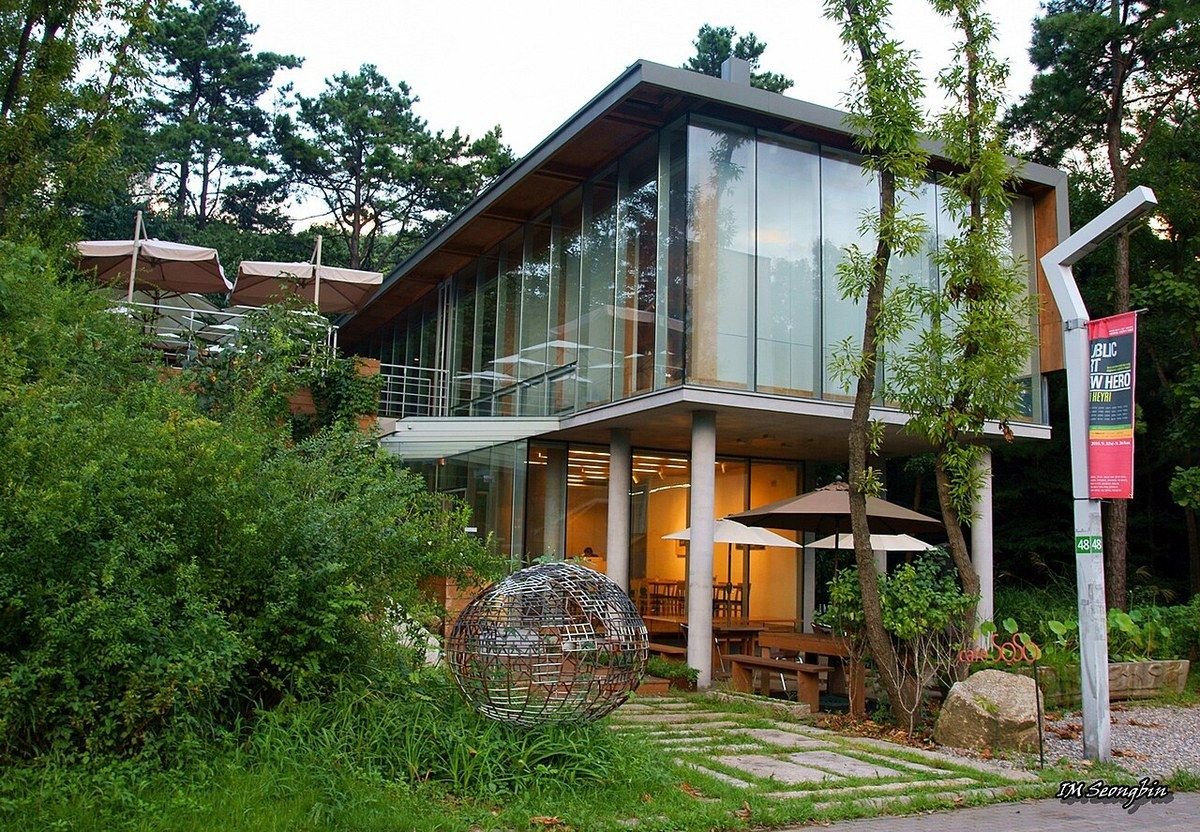
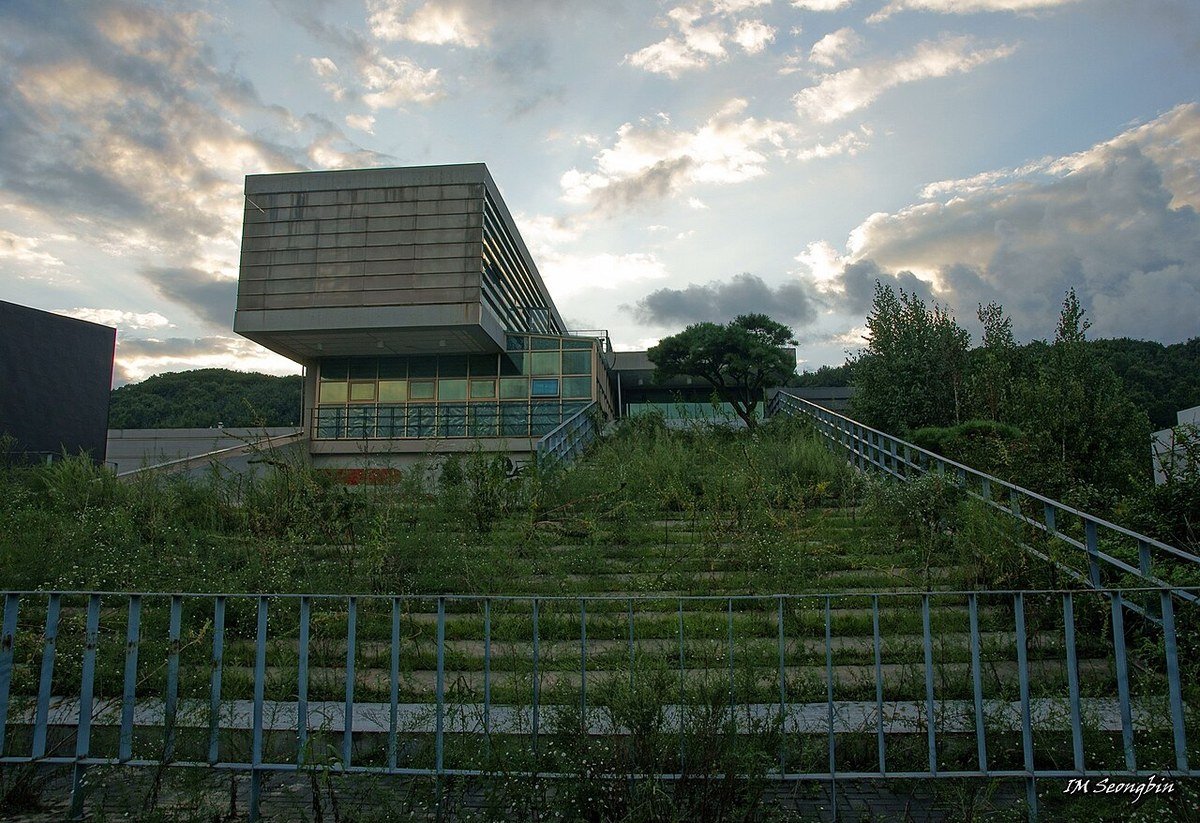
- Body photo originals: stream-side buildings, Gallery SoSo, Art-Service, Keumsan Gallery (Wikimedia Commons)
Leave a Reply